
Skepticism about business coaching is reasonable. The industry is crowded with people offering motivation, accountability, and general advice that could apply to any business. If you’ve looked into coaching and walked away unconvinced, that reaction makes sense.
The problem is that skepticism often turns into waiting. And waiting is usually the most expensive decision a practice owner makes.
Why the skepticism is understandable
Generic business coaching often misses the central tension in private practice: the owner is also a clinician. That dual identity creates specific pressure that most business frameworks don’t account for.
Advice built for a retail business or a tech startup doesn’t translate cleanly to a practice where:
- Your clinical reputation is tied to the brand
- Your team is made up of fellow clinicians
- Stepping back from patient care feels like abandoning something important
A private practice business coach who has actually owned and operated a practice understands that tension. One who hasn’t will give you frameworks that sound right but don’t fit.
The other source of skepticism is more personal. You’ve built something real on your own. Asking for outside help can feel like admitting something isn’t working. That feeling is understandable, and it’s also one of the main reasons owners stay stuck longer than they need to.
What owners usually try first
Before seriously considering a coach, most owners cycle through a predictable set of alternatives:
- Hiring more staff, hoping more hands will reduce the pressure
- Investing in new software, expecting better systems to create more order
- Attending conferences and collecting ideas they don’t have time to implement
- Promoting a strong clinician into a management role without giving that person a real framework to lead from
None of these are wrong moves on their own. Without the structure to support them, though, they tend to create new problems rather than solve existing ones. The staff hire adds payroll and management overhead. The promoted clinician struggles without clear expectations and either burns out or drifts back to clinical work.
The pattern continues because the underlying structure hasn’t changed. The owner keeps carrying the weight.
What a private practice business coach actually does
This is where the confusion usually lives. A coach isn’t someone who checks in weekly, asks about your goals, and holds you accountable to a to-do list. The right coaching relationship does something more specific: it helps you see the structure of your business clearly and gives you a framework for changing it in a way that sticks.
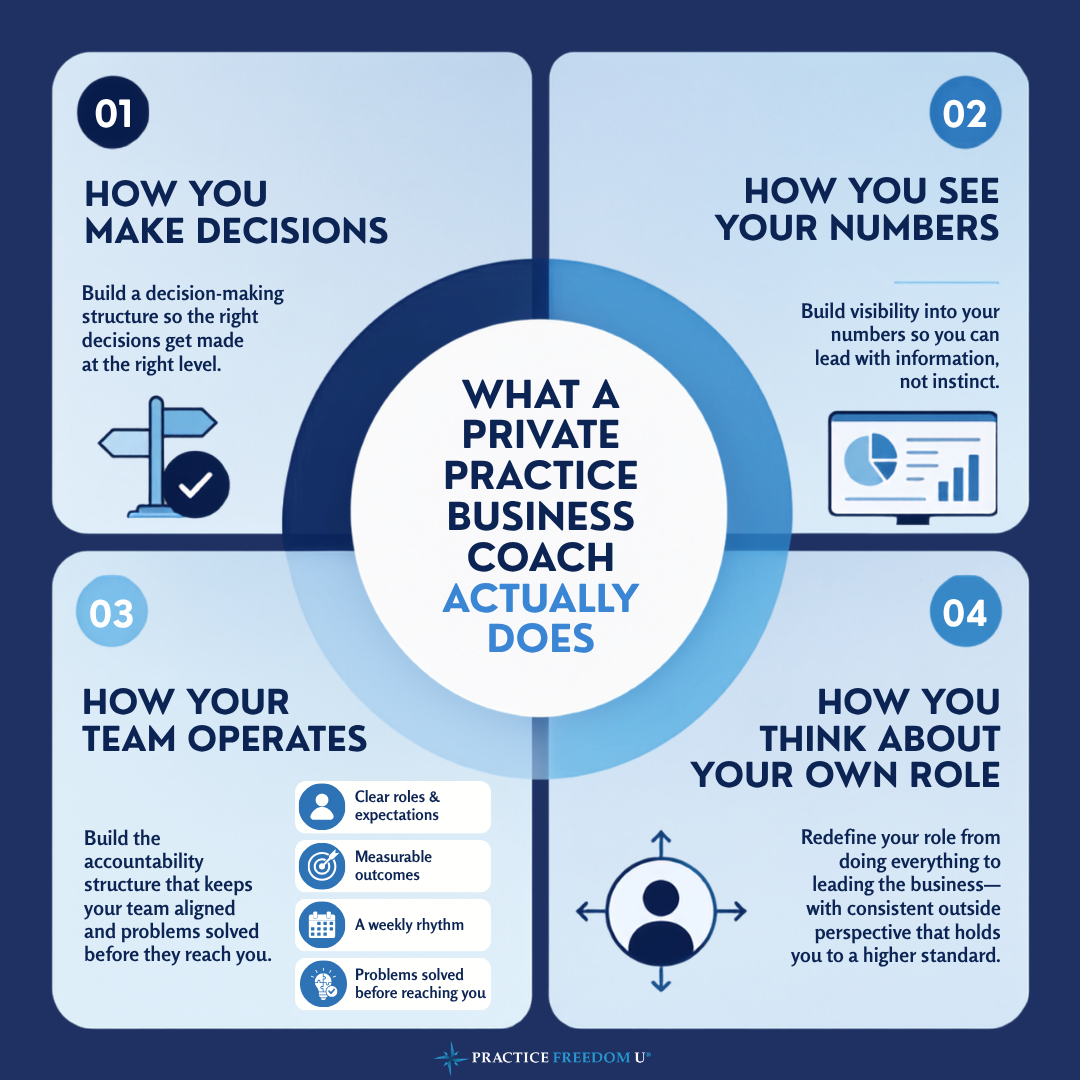
When it’s working, four things shift inside the practice.
How you make decisions
Most owners make decisions reactively. A problem surfaces, they solve it. A question comes in, they answer it. A staff issue escalates, they step in. This keeps things moving, but it also means the owner is the ceiling. Nothing moves faster than your personal availability.
Coaching helps you build a decision-making structure so the right decisions get made at the right level. Your team starts handling what they should be handling, and your time shifts toward the business instead of staying trapped inside it.
How you see your numbers
You probably know your revenue. Fewer owners have a clear view of profit, and most don’t have a weekly dashboard that tells them whether the business is healthy before the end of the month.
The right coach helps you build that visibility, not just what to track, but how to use the numbers to make better decisions. When you can see the business clearly, you stop managing by instinct and start leading with information.
How your team operates
One of the most consistent patterns in overwhelmed practices is a team that brings everything back to the owner. The team isn’t weak; the structure around them doesn’t give them clear ownership of outcomes.
Coaching helps you build the accountability structure that addresses this:
- Clear roles and expectations
- Measurable outcomes each person owns
- A weekly rhythm that keeps the team on track
- Problems that get solved before they reach you
How you think about your own role
This is the most important shift, and the hardest one to make without outside perspective. When your value has always been defined by what you personally do, treating patients, managing staff, staying visible, it takes real work to redefine it. That shift doesn’t happen by reading about it. It happens through consistent outside perspective that holds you to a different standard.
What this looks like in practice
Jacob grew his practice from roughly $750K to over $3.6M and expanded to 16 therapists. The shift wasn’t just revenue growth. He built a business that no longer depended on him being there every day.
Kristin came in overwhelmed and carrying everything. Coaching helped her step back, build stronger systems, and create a practice that could operate without her in the middle of it.
Juli found that the value went beyond business structure. The outside perspective helped her break through patterns that had been holding her back for years.
Frank puts it simply: having someone experienced in your corner changes how you lead, how you think, and how you grow your practice.
The common thread across all of them isn’t a single tactic or framework. It’s the shift that happens when someone who has been inside a practice helps you see yours from the outside.
Why owners wait too long
The owners who benefit most from coaching almost always say the same thing afterward: they wished they had started sooner.
The logic of waiting is easy to follow. When things are going reasonably well, it’s tempting to believe the problems will work themselves out. When growth is happening, it feels wrong to slow down and examine the structure underneath it. When the business is struggling, spending on coaching can feel like a risk.
The cost of waiting is real, though. A PricewaterhouseCoopers and ICF global study found organizations that invest in coaching report an average return of seven times the cost. Owners who get coaching before the pressure becomes a crisis have more capacity to implement what they learn and more runway to see results.
Every month spent solving the same problems, carrying the same weight, and staying stuck in the same role is a month the business isn’t building toward something better. Owners who get coaching before the pressure becomes a crisis have more capacity to implement what they learn and more runway to see results.
Waiting until you’re desperate is the most expensive version of getting help.
How to know if you’re ready
You don’t need to have everything figured out. You do need a few things to be true:
- You’re willing to examine the structure of the business, not just how hard you’re working
- You’re open to changing your own role, not just improving your team
- You’re ready to act on what you learn
According to Harvard Business Review, the person being coached has to be ready and willing, and they need to be able to act on what they learn.
If those things are true, the right coaching relationship will likely move your practice further in the next six months than the last two years on your own.
A private practice business coach isn’t a motivator or a cheerleader. The right one has been inside a practice, understands the pressures specific to this work, and helps you build a business that depends less on you over time.
————————————————————-
Are you ready for a coach? Join the hundreds of physical therapy owners who are building the practice of their dreams with the support, guidance and direction of a Practice Freedom U Coach. Take the first step towards creating a business that sets you free by scheduling a Discovery Call