
Every business runs on a vision.
Not the one written in a document, not the one discussed in planning sessions, but the one you can see in how the business actually operates.
Look at how work moves through your business, how decisions are made, what gets attention, what gets delayed, how consistent things feel from week to week. That pattern is not random, it reflects a version of what the business has become over time.
In most cases, that version was never clearly defined. It formed through habits, quick decisions, and whatever was needed to keep things moving. Once that pattern settles in, it starts to repeat itself.
That becomes the default.
Where the Disconnect Comes From
Most owners can describe what they want the business to become.
They want something more stable, more predictable, more structured, something that does not feel like it needs constant adjustment just to stay on track.
That direction usually exists in their head, sometimes in notes, sometimes in conversations.
At the same time, the business continues to run the way it always has.
The gap between those two versions does not always feel urgent at first. Over time, it becomes familiar. The business keeps producing the same patterns, and the vision starts to feel like something that belongs in the future instead of something that should already be taking shape.
Why Vision Stays Conceptual
A vision only becomes useful when it starts influencing how the business operates.
That means it has to move beyond description and into decisions.
Most visions stay broad, which makes them easy to agree with, but difficult to apply. The moment a vision becomes specific, it starts to narrow the path forward. Certain priorities become clearer, other things no longer fit as easily, and that creates friction.
Without that level of definition, the business continues to respond to what is in front of it. Urgent work gets handled, immediate problems get solved, and the overall direction stays unchanged. (AMA)
What Follow-Through Actually Looks Like
Follow-through shows up in how the business runs day to day. It becomes visible in patterns, not in plans.
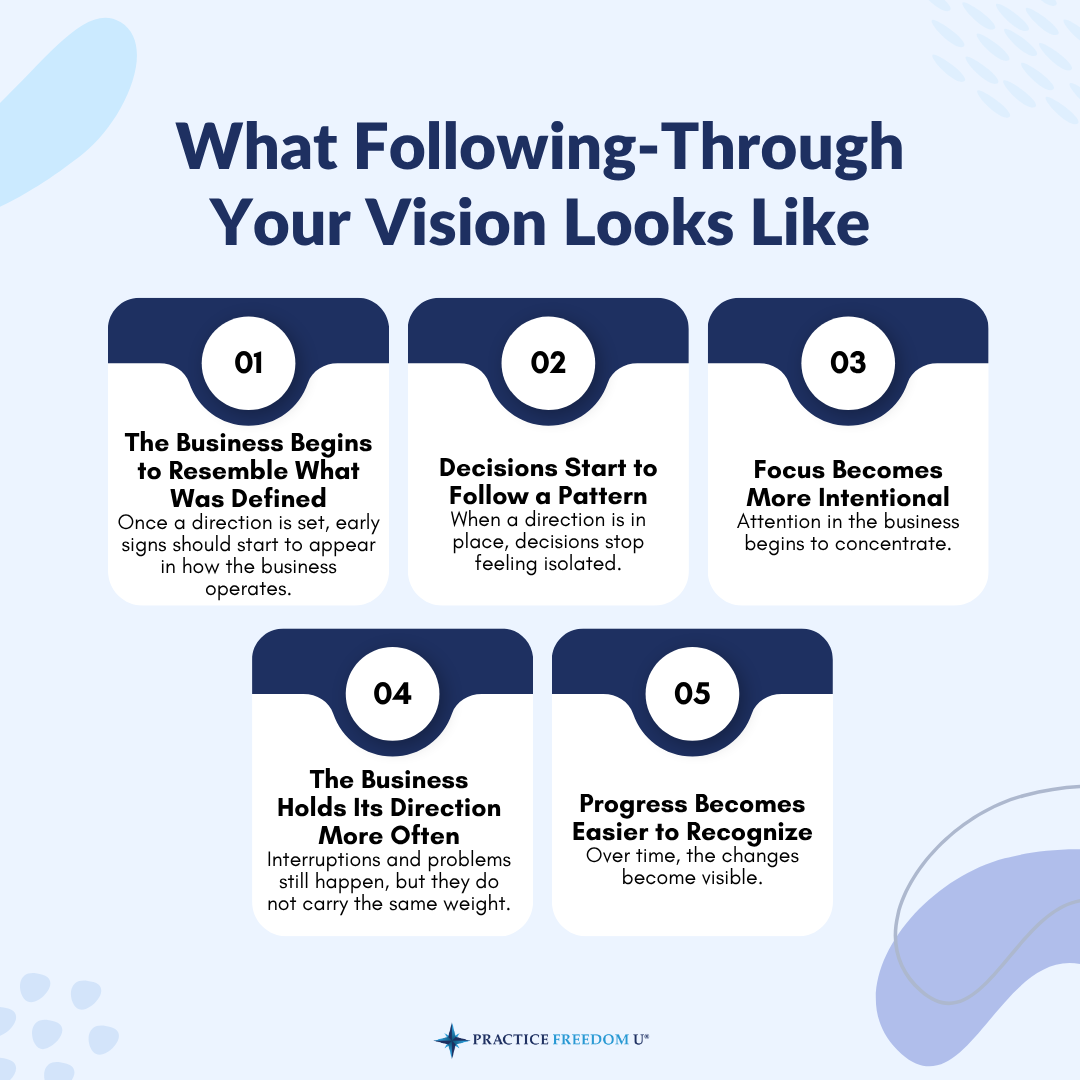
The Business Begins to Resemble What Was Defined
Once a direction is set, early signs should start to appear in how the business operates.
Work begins to move in a more consistent way, expectations become clearer, and there is less variation in how things are handled. It does not need to be fully built out, but it should feel like the business is moving toward something specific, not just continuing as it was.
Decisions Start to Follow a Pattern
When a direction is in place, decisions stop feeling isolated.
There is a connection between what is being prioritized and where the business is going. You can look at what is getting attention and see that it lines up with a defined path, not just whatever happens to come up.
Focus Becomes More Intentional
Attention in the business begins to concentrate.
Instead of shifting constantly, certain areas receive consistent focus because they are tied to the direction that has been set. Other areas naturally receive less attention, which helps reduce the sense of everything competing at once.
The Business Holds Its Direction More Often
Interruptions and problems still happen, but they do not carry the same weight.
They get handled without pulling the business off course. There is a stronger sense of direction that holds, even when things get busy, which makes the overall movement of the business feel more steady. (PIT.edu)
Progress Becomes Easier to Recognize
Over time, the changes become visible.
You can see improvements in consistency, predictability, and how aligned the business feels with what was originally intended. The gap may still exist, but it starts to close in a way that is noticeable.
Why This Is Often Missed
It is easy to assume that having a clear vision is enough.
In reality, clarity only becomes valuable when it starts shaping how the business runs.
Without that connection, the business continues to operate based on existing patterns. Activity increases, effort increases, but the underlying structure stays the same.
That is why it can feel like progress is being made without anything really changing. (Forbes)
Where to Start
The simplest place to begin is by looking at what your business is already doing.
Not what you planned, but what is consistently happening.
From there, the question becomes whether that matches the direction you have in mind, or whether the business is still following an older version that was never fully defined.
The Practice Freedom Assessment is designed to give you that view.
It will show you how your business is currently operating and where it does not line up with the direction you want to take it.
No pressure, no pitch, just clarity and direction.
————————————————————-
Are you ready for a coach? Join the hundreds of physical therapy owners who are building the practice of their dreams with the support, guidance and direction of a Practice Freedom U Coach. Take the first step towards creating a business that sets you free by scheduling a Discovery Call