

Most practice owners assume a schedule gap means they need more referrals. That assumption feels logical, but it is often wrong. You do not always have a referral generation problem. More often, you have a referral leakage problem.
That means people are entering your world, but they are not making it all the way through. They call but do not book. They book but cancel. They show up once and never return. They get referred but never hear from your team quickly enough. They reach out online and disappear before anything meaningful happens.
From the outside, this looks like a marketing issue. Inside the business, it is almost always a systems and ownership issue. This is where time and money get wasted. You push harder on marketing, outreach, and visibility while ignoring the fact that patients are leaking out of your process every single day.
The real question is not, “How do I get more referrals?” The better question is, “Where are they being lost?”
What Referral Leakage Actually Means
Referral leakage is what happens when potential patients enter your pipeline but do not become active, consistent care. It is the drop-off between interest and revenue, and it exists in every practice whether you are tracking it or not.
You can have strong demand and still feel constant pressure because the handoffs are weak. A physician can send patients, your marketing can generate leads, and your community can know your name, yet your schedule still has gaps. That disconnect is not random. It is a breakdown in the process.
In real life, this shows up in very specific ways. A patient reaches out and your team responds too late, so they move on. A lead comes in and no one clearly owns the follow-up, so it falls through. A patient arrives for their first visit unsure about cost or next steps, which creates hesitation before care even begins. A clinician explains the problem but does not confidently guide the plan, so the patient never fully commits. A cancellation happens and no one works to recover the visit, leaving empty space on the schedule. (MGMA)
Individually, these moments seem small. Together, they create a consistent pattern of lost opportunity.
Why This Problem Stays Hidden
This problem stays hidden because everything feels like a volume issue. When the schedule is not full, the instinct is to get more people in. You think about marketing, physician outreach, community events, and anything that increases visibility.
But if the intake and care process is weak, more leads do not solve the problem. They amplify it. You end up creating more opportunities for breakdown, which leads to more frustration and higher costs without better results.
This is why many practice owners feel like they are working harder but not seeing progress. They are solving for volume when the real issue is conversion and consistency.
The 5 Places Patients Usually Drop Off
If you want to fix this, you need to stop treating referrals as one broad concept and start looking at the specific points where patients drop off. These points are predictable, measurable, and fixable.
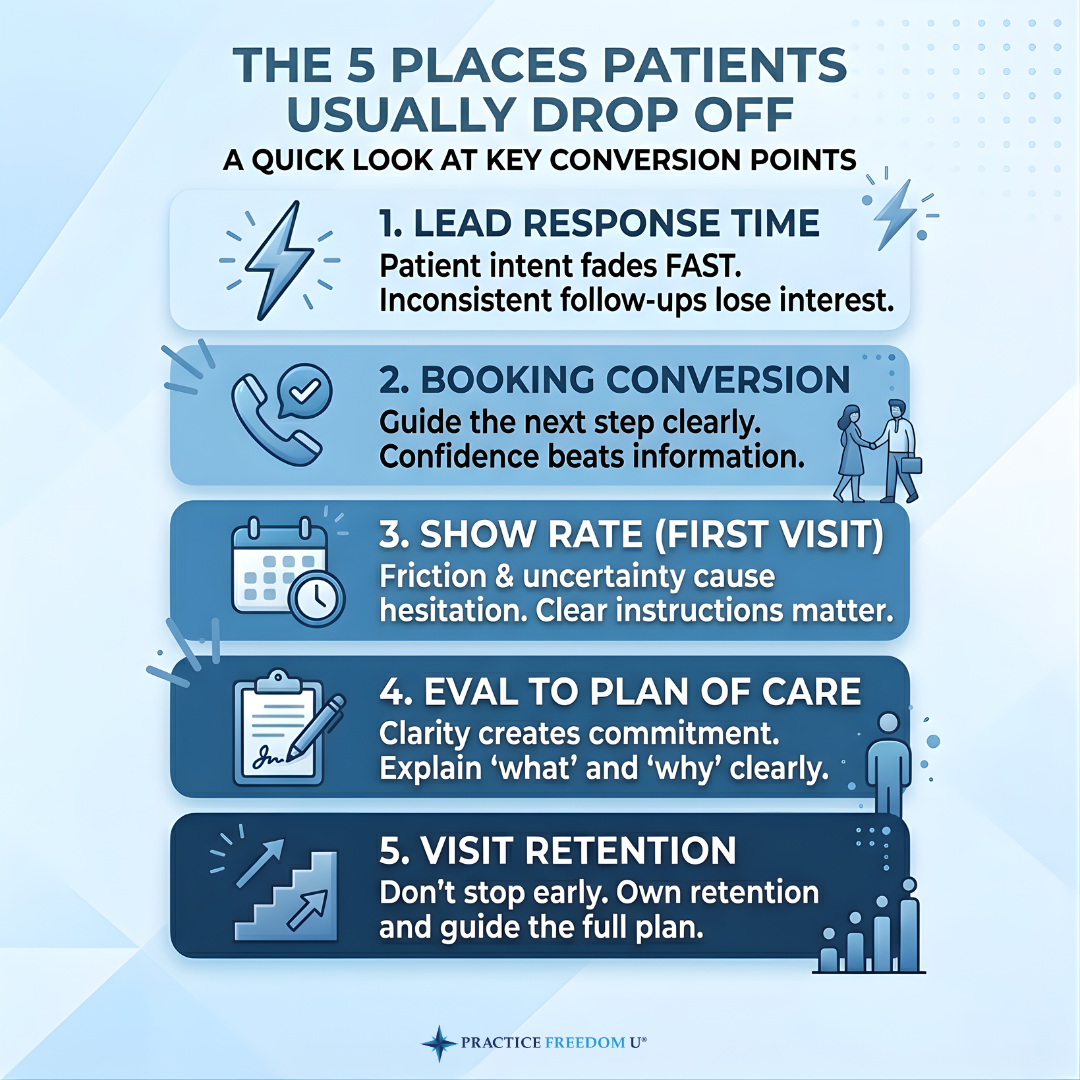
1. Lead Response Time
How fast does someone hear from your team after reaching out? Not on your best day, but on a normal day. If the answer is inconsistent, that is the problem. Patient intent fades quickly, especially when they are in pain or uncertainty. Even a short delay can shift their decision.
2. Booking Conversion
Not every inquiry becomes an evaluation. This is where communication matters. A passive conversation leaves the decision up to the patient, while a confident conversation guides the next step clearly. The difference is not information, it is leadership.
3. Show Rate for the First Visit
A booked evaluation is not the same as a kept evaluation. Patients no-show when there is friction or uncertainty. If they are unclear on what to expect, what it will cost, or why it matters, they hesitate. That hesitation often leads to a missed appointment.
4. Eval to Plan of Care Conversion
A patient can show up and still not commit to care. If they do not clearly understand what is wrong, what it will take to fix it, and why consistency matters, they will delay or drop off. Clinical skill alone does not create commitment. Clarity does. (PLOS ONE)
5. Visit Retention
Even after starting care, patients continue to drop off. They cancel, reschedule, reduce frequency, or stop early once they feel some relief. If no one is actively owning retention and guiding the plan, this becomes normal behavior instead of an exception. (JOSPT)
The Real Issue Beneath All of This
Most referral leakage is not caused by poor effort. It is caused by vague ownership. When no one clearly owns the outcome, everyone assumes someone else is handling it.
You have to ask direct questions. Who owns response time? Who owns booking conversion? Who owns kept evaluations? Who owns making sure the patient is fully scheduled? Who owns recovering cancellations?
If the answers are unclear or shared across multiple people without accountability, the system will continue to fail. And when it fails, the responsibility falls back on you. That is why this problem feels so heavy. It keeps pulling you back into the center of the business.
What to Fix First, Starting Now
You do not need to fix everything at once. The goal is to tighten the parts of the process where patients are already trying to enter your business.
Audit the Patient Path
Start with one week of data. Track every new inquiry and referral from first contact to first completed visit. Do not generalize. Look at specific cases and identify exactly where each breakdown happens.
Assign One Owner
New patient flow needs a single owner. Not a group and not shared responsibility. One person is responsible for the outcome, even if multiple people are involved in the steps. This creates clarity and consistency.
Standardize Key Conversations
Your team should not be guessing what to say in critical moments. Calls, confirmations, and follow-ups need to be structured and consistent. This does not remove personality. It removes variability that leads to lost patients.
Track Weekly Metrics
Monthly revenue is too delayed to guide action. You need weekly visibility into inquiries, evaluations booked, evaluations kept, plans of care started, and cancellations recovered. These numbers show you exactly where to focus.
Train Your Team to Lead
Patients need guidance, not just information. Your team must be able to confidently lead the next step in care. When patients feel clear and supported, they commit. When they feel uncertain, they hesitate.
What Happens When You Fix Leakage
When you fix leakage, the business begins to feel different. The same number of referrals produces more completed plans of care, more consistent schedules, and more predictable revenue. You stop feeling like you need to constantly chase new leads just to stay afloat.
Instead of reacting to gaps, you start seeing a stable system. Instead of carrying the weight yourself, the process begins to hold its own. That shift is what creates real momentum.
If your schedule still has gaps and you are not sure where patients are dropping off, this is worth solving now. The fastest way to grow is often not getting more referrals, it is fixing what is already happening inside your business.
Schedule a call to walk through your patient flow and identify exactly where the breakdown is happening. You will leave with clarity on what to fix first and how to move forward with confidence.
————————————————————-
Are you ready for a coach? Join the hundreds of physical therapy owners who are building the practice of their dreams with the support, guidance and direction of a Practice Freedom U Coach. Take the first step towards creating a business that sets you free by scheduling a Discovery Call