
Trust is the missing ingredient in every task you technically handed off.
You hired someone to do it.
You still do it yourself.
They can do it. Part of you just doesn’t fully believe they will.
Delegating with trust means the job is actually gone, not reassigned on paper while you keep one hand on it.
The pattern behind holding on
This shows up in call after call. One owner had grown a team big enough to stop writing every note personally.
They kept writing every note personally anyway.
A quiet check, a small rewrite, a redo after the clinician had already gone home.
The task lived on the org chart, delegated in name, still theirs in practice.
If you run a physical therapy, occupational therapy, speech, or mental health practice, you’ve done a version of this. The org chart says someone else owns it. Your hands are still on it.
Letting go feels riskier than it actually is
Business owners tend to score high on internal locus of control, the belief that outcomes depend on your own actions rather than luck or other people.
That belief is part of what built the practice in the first place.
It also has a cost. Research on entrepreneurs shows that a stronger internal locus of control predicts a stronger preference for retaining control over decisions, even when handing them off would produce a better outcome, according to a 2024 study on locus of control and delegation.
The same instinct that built the business quietly blocks it from outgrowing you.
Trust runs through the front desk too
The person answering your phones is shaping patient loyalty as much as the clinical care is.
Give that person room to fix a problem on the spot, and they usually will.
Require every fix to route back through you, and they’ll stop trying.
Frontline staff who are trusted to solve small problems immediately create the kind of experience that keeps patients coming back, research on frontline empowerment and customer experience shows.
Withholding that trust slows the fix and trains your team to stop bringing you solutions at all.
Delegating with trust, on purpose
Rebuilding trust in your team takes a few deliberate moves, not a personality overhaul.
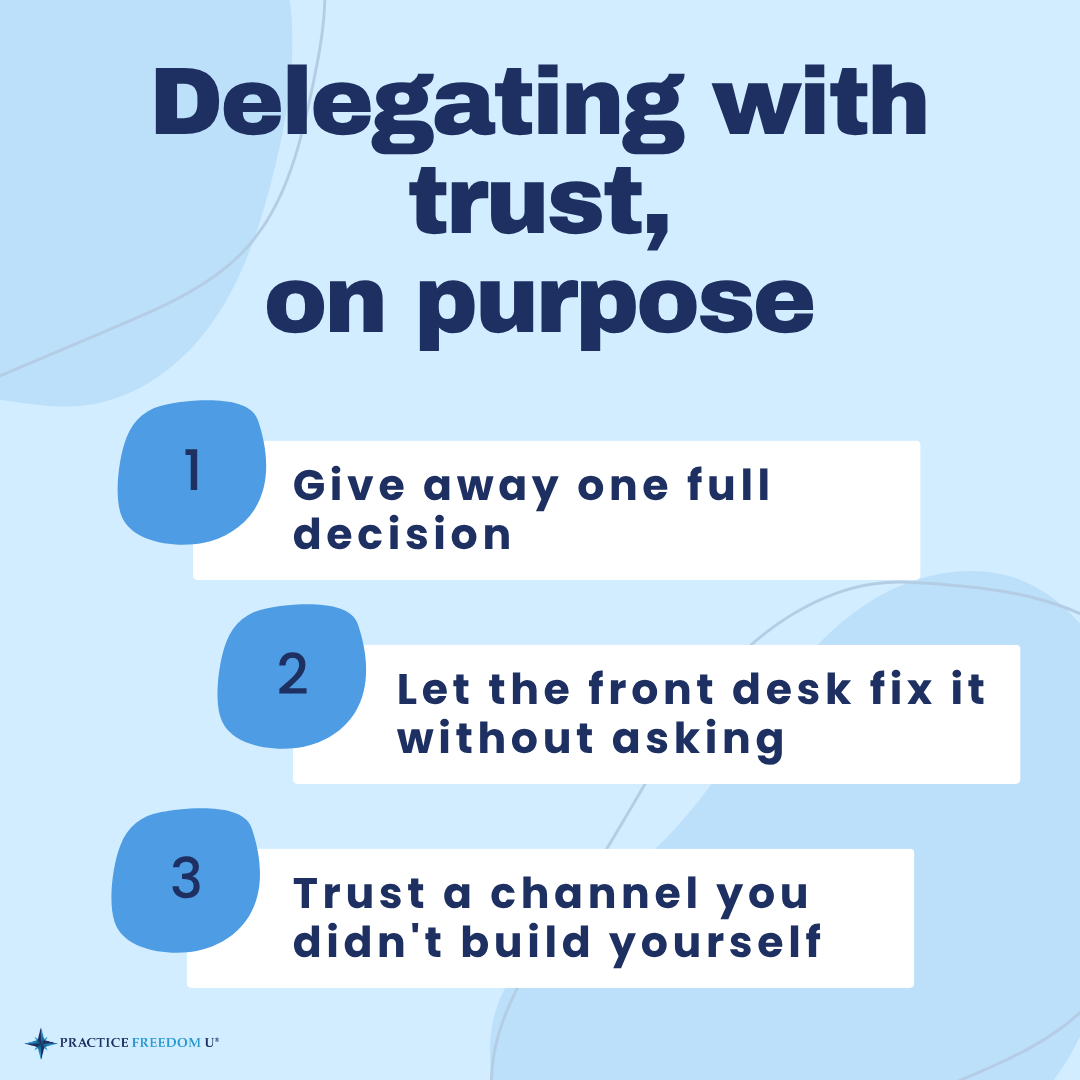
Give away one full decision
Pick one recurring decision and hand over the whole thing, start to finish, no check-in required.
Employees who trust their leaders are far more likely to stay, Gallup’s research on workplace trust has found. Trust runs in both directions. Extending it is part of what earns it back.
Let the front desk fix it without asking
Set a clear, small dollar limit or a short list of situations your front desk can resolve on their own, no approval required.
Small and fast beats correct and slow, almost every time a patient is standing in front of them.
Trust a channel you didn’t build yourself
Referrals feel safe because you understand exactly where they come from.
A new marketing channel feels risky because you don’t control every variable in it. Give one new channel a real test, on its own terms, before deciding it doesn’t work.
Start with the note you rewrite
Pick the one thing you redo after someone else already finished it.
Let the next one stand, unedited, even if it’s not exactly how you’d have done it.
That’s the whole first step, and it’s the one most owners skip.
Freedom By Design, Season Two

This is exactly what came up in three recent conversations on Freedom By Design with Jerry Durham, Karen Litzy, and Neil Trickett.
Season two is out now on Apple Podcasts, Spotify, and YouTube. These three conversations go deeper into what it actually takes to trust the people and systems you’ve already built.
————————————————————-
Are you ready for a coach? Join the hundreds of physical therapy owners who are building the practice of their dreams with the support, guidance and direction of a Practice Freedom U Coach. Take the first step towards creating a business that sets you free by scheduling a Discovery Call