
Stepping back from treating is a scheduling change. What comes next has to be a structural one.
Stepping off the treatment schedule feels like the finish line. You built the team, grew the revenue, got out of the clinic chair. That was supposed to be the reward.
Then it happened, and the days didn’t get lighter. The phone still rings with the same questions. The team still needs direction on decisions you assumed they’d handle. The practice still runs through you, just without the patients in between.
The thing you worked toward arrived and the pressure stayed right along with it. That experience is more common than owners expect, and it points to something worth understanding.
What actually changed when you stopped treating
Removing yourself from the schedule solved one problem: your hours in the clinic. Everything the practice was routing through you before, decisions, approvals, problem-solving, team direction, kept routing through you after.
Treating was visible and time-consuming, so it felt like the problem. The actual load was structural. Structure doesn’t shift because the schedule does.
Owners who step back after years of being the center of the operation often find the systems were never built because they were always available to fill the gap personally. When the schedule clears, the gap is still there.
Where the workload actually goes
When owners describe still feeling buried after getting off the schedule, the time isn’t going to one obvious place. It fragments across a dozen smaller things that each seem reasonable on their own.
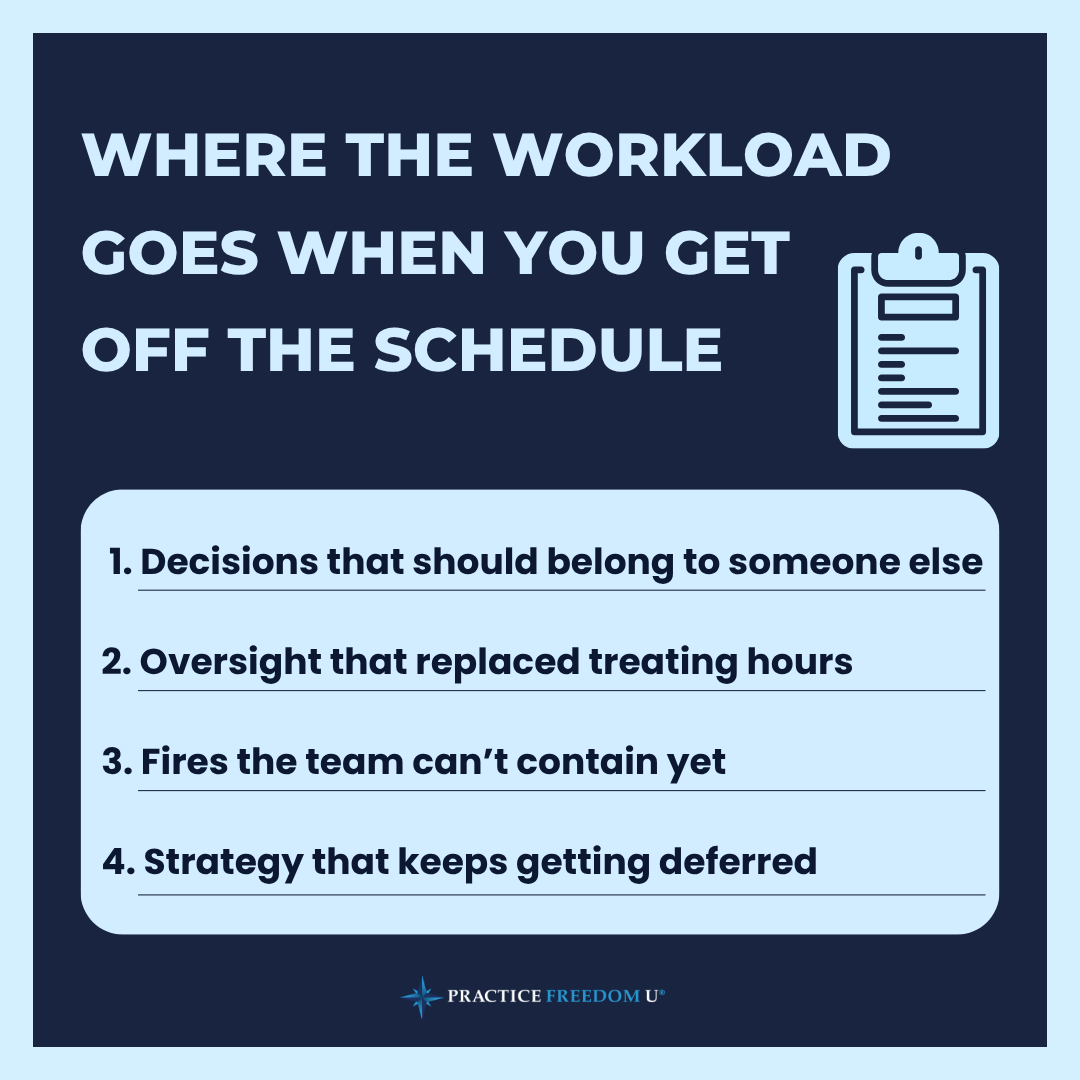
Decisions that should belong to someone else
The team has grown. On paper, decisions should flow through the clinical director or office manager. In practice, they still flow to you. Some of this is habit: the team learned to bring things to you because you were always there and always had an answer. Some of it reflects that the boundaries around who owns what were never drawn clearly.
Until each role has defined ownership over specific outcomes, the path of least resistance is always the owner. The team isn’t doing anything wrong. They’re working within the structure they were given.
Oversight that replaced treating hours
Many owners trade patient hours for management hours without noticing. The schedule opens up and rather than that time becoming strategic, it becomes observation time: more meetings, more check-ins, more reports reviewed.
Oversight feels productive. At this stage, it rarely is. A practice that runs on the owner’s watchfulness rather than documented systems is still dependent on that person being present, whether a sale is on the table or not.
Fires the team can’t contain yet
Staff conflicts. A clinician considering leaving. A referral relationship going cold. These situations land on the owner because the leadership layer isn’t equipped to handle them independently yet.
Each one seems like a reasonable exception. Over enough time, exception-handling becomes the primary job, and that tends to be more draining than the treating schedule it replaced.
Strategy that keeps getting deferred
When the workload stays high, the thinking time that was supposed to come with the transition never materializes. Conversations about where the practice is going, what the next three years look like, whether the current model still fits, keep getting pushed because something more pressing is always in the way.
A practice at this size needs the owner working on the business. When that doesn’t happen, growth plateaus and the reason stays invisible because the owner is too close to the daily operation to see it from the outside.
Why a schedule change isn’t enough
Getting off the treatment schedule is a necessary move. On its own, it’s not sufficient.
Two things have to change that the schedule doesn’t touch. Real delegation, which means transferring ownership of outcomes to specific people with the authority to decide and the accountability to produce results, not handing off tasks while staying involved in how they get done. And a leadership layer that can actually lead.
A clinical director who manages schedules is a different role than one who owns the clinical operation. An office manager who keeps things organized is a different role than one who identifies problems early and drives solutions without being asked.
The distinction matters because owner dependence is one of the most significant factors affecting both the value and marketability of a business. A practice built around the owner’s oversight rather than its own operating structure carries that cost long before any sale is considered.
What changes when the structure catches up
The owners who describe genuinely getting their time back after stepping off the schedule share a common pattern. The schedule change came alongside deliberate structural work: roles with defined outcomes, a leadership team that owned its lane, a weekly rhythm the practice ran on without the owner being the connective tissue between departments.
The time doesn’t appear automatically. It has to be designed, by deciding what the owner’s role actually is at this stage and building the structure that makes everything else run without them filling the gaps.
This is the same principle Harvard Business Review points to in its research on scaling businesses: the owners who successfully transition out of daily operations aren’t the ones who stepped back furthest. They’re the ones who built the clearest structure before stepping back at all.
If the workload didn’t change when the schedule did, the schedule was never where the weight was coming from.
The pressure in a practice at this level lives in the structure: who owns what, whether the leadership layer can carry real responsibility, whether the systems exist or whether the owner’s presence is still the system. Changing that takes longer than adjusting a schedule. It also produces something the schedule change alone never can.
For more on building the structure that gives the time back, listen to Freedom By Design on Apple Podcasts, Spotify, or YouTube.
————————————————————-
Are you ready for a coach? Join the hundreds of physical therapy owners who are building the practice of their dreams with the support, guidance and direction of a Practice Freedom U Coach. Take the first step towards creating a business that sets you free by scheduling a Discovery Call