

One of your longest-tenured clinicians just asked how their pay compares to the person you hired six months ago. You didn’t have a clean answer, only a story about how each rate came to be.
That story is the problem.
Every raise you gave to keep someone from walking, every rate you bent to land a hire, every number you set to make the moment work, all of it made sense at the time. None of those decisions were built to sit next to each other.
As you added locations and service lines, you multiplied the pay decisions nobody has connected into one picture. That collection of one-off calls is now your pay structure, and your team reads it faster than you do.
Pay That Grew Without a Plan
Your pay structure is the sum of many separate decisions, each made without the others in view: a person about to leave, an offer you had to match, a hire who negotiated hard on the way in. Every one was reasonable on its own day.
That is how you end up with two people doing nearly the same work for different pay, and no clean explanation for the gap.
When you had one location, you could hold all of it in your head. Growth ends that. More roles and more locations create more numbers than anyone tracks by feel, and the gaps that once lived only in your head are now visible to everyone except you.
Your Best People Notice, and You Misread the Turnover
The person most likely to notice is the one who has been with you longest. They remember what they made three years ago, they know what the market pays, and they have watched every newer hire come through the door.
When a new clinician starts near what a five-year veteran makes, the veteran does the math before you do. It rarely shows up as a complaint. Your strongest people go quiet, take a recruiter’s call, and give notice with a reason vague enough to keep the door open.
When they go, you reach for the wrong explanation. You look at engagement, at management, at whether the mission stopped landing. None of it touches the problem, because the problem is arithmetic. What pushes your best people out is the comparison. They measure the distance between their pay and everyone else’s, and the moment that distance stops making sense, they are gone.
In a conversation with a practice owner running several locations, the turnover read as a loyalty problem for months. Laid out role by role on a single page, the pattern was obvious and had been there the whole time.
The Cost of Losing Your Best Clinicians
Losing a tenured clinician is not a soft cost. Once you account for recruiting, onboarding, and the ramp before a replacement reaches full speed, replacing an experienced employee can run as high as twice their annual salary.
The pressure is sharper in this field. Turnover across rehab therapy already sits above the broader healthcare average, and pay ranks among the top three reasons owners believe they lose people, named by roughly two-thirds of those surveyed. The same squeeze runs through physical therapy, occupational therapy, speech, and mental health practices alike.
Now apply that to your strongest people, the ones with the heaviest caseloads and your key referral relationships. Each departure resets progress, referral sources notice a familiar face is gone, and the rest of your team absorbs the overflow while running their own math on whether staying makes sense.
A structure that saves you a few thousand dollars in raises can cost you many times that in turnover you never trace back to its source.
Building a Pay Structure by Design
The fix is a structure you can defend, apply consistently, and adjust on a schedule you set. Building it takes a few deliberate steps.
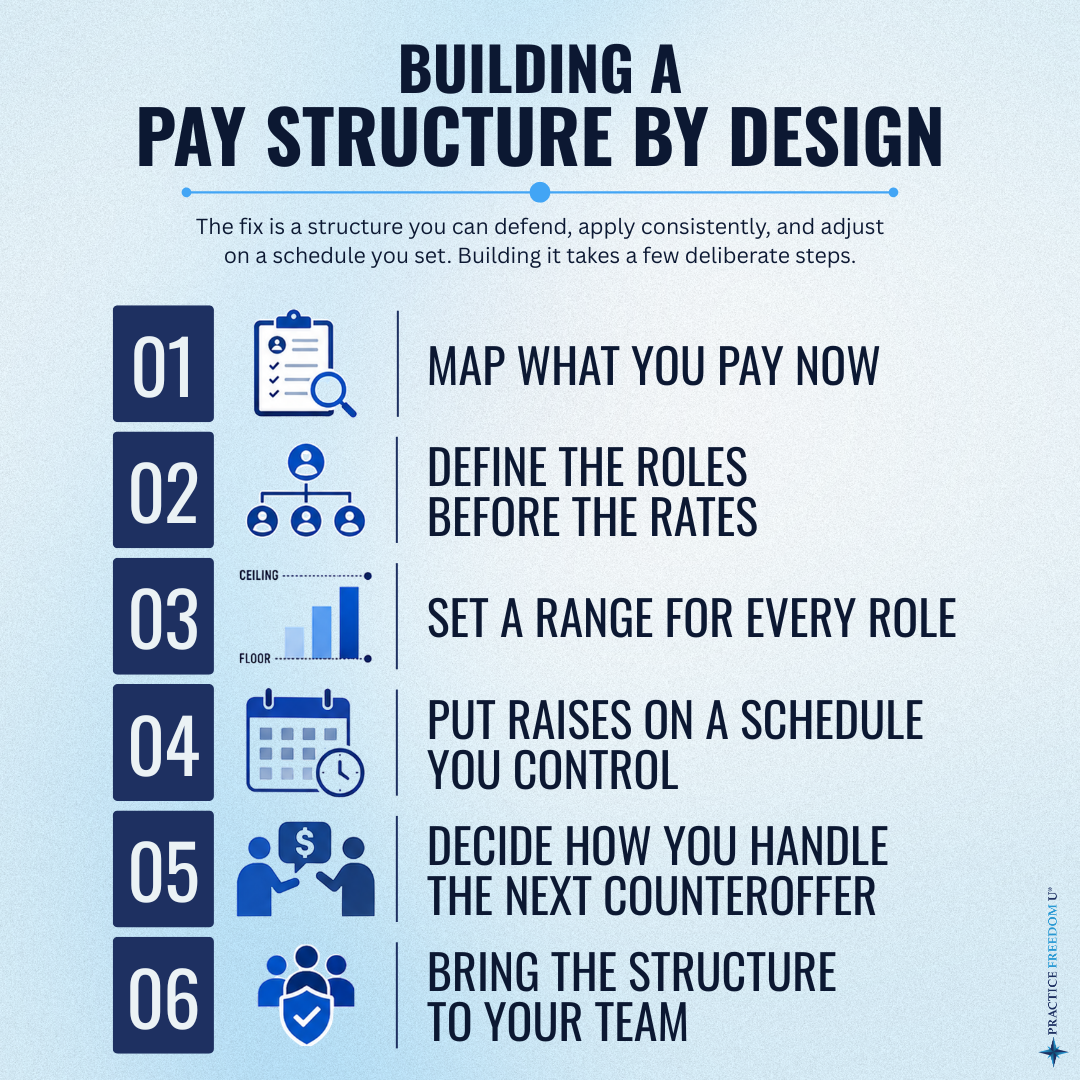
Map What You Pay Now
Put every role and every person on one page. Name, role, location, current pay, hire date, and last increase.
You are looking for the gaps you have been carrying in your head. Two people doing the same job at different numbers. A newer hire sitting above a veteran. A location that pays more for reasons no one remembers.
You cannot fix a structure you cannot see. This page is the structure, finally out where you can work on it.
Define the Roles Before the Rates
Before you touch a single number, get clear on the roles themselves.
What does each role actually own? What separates a clinician from a senior clinician from a lead? If the only difference between two levels is tenure or an old negotiation, you have a title, not a role.
Rates only make sense once roles do. Two people at the same level should sit in the same range, wherever they work and however they were hired.
Set a Range for Every Role
Give each role a floor and a ceiling. The floor is your starting point for a new hire. The ceiling is the most that role earns before a move up to the next level.
Ranges let you reward experience and performance without inventing a new deal every time.
They also give you a clean answer when someone asks why they earn what they earn: the role, and where they sit inside its range.
Put Raises on a Schedule You Control
Most pay problems start with raises that only happen when someone forces the issue.
Set a rhythm instead. Review pay on a fixed cycle, once or twice a year, against the ranges you built. Tie movement inside a range to defined criteria that apply to everyone.
When raises run on a schedule, you stop negotiating under threat. The person who would have cornered you in the hallway already knows when their pay gets reviewed and what moves it.
Decide How You Handle the Next Counteroffer
The counteroffer is where structures quietly die.
Someone brings you an outside offer. You match it to keep them, and in one move you have pushed a person above their range and above peers who never threatened to leave.
Decide your rule before the moment arrives. You might hold firm on the range and accept that a strong person occasionally walks. You might build a clear, defensible exception process. Either way, make that choice while you are calm and not sitting across from someone with one foot out the door.
Bring the Structure to Your Team
A pay structure you keep to yourself solves half the problem.
Your team does not need to see everyone’s number. They need to know that a structure exists, that roles have ranges, that raises follow a schedule, and that the same rules apply across every location.
That visibility is what rebuilds trust. The quiet math your best people were running finally meets a system they can point to.
The Work Underneath the Turnover
You built something big enough that it can no longer run on memory alone. Left unexamined, your pay structure keeps making decisions for you, and the people who cost you the most to lose are the ones reading it most closely.
Bring this to your next leadership conversation: does your pay structure hold up when it is laid out on one page, or does it only make sense in your head?
__________________________________________________

If you want more of how owners work through problems like this one, my podcast Freedom by Design, gets into exactly these shifts. You can listen or watch on Apple Podcasts, Spotify, or YouTube.
————————————————————-
Are you ready for a coach? Join the hundreds of physical therapy owners who are building the practice of their dreams with the support, guidance and direction of a Practice Freedom U Coach. Take the first step towards creating a business that sets you free by scheduling a Discovery Call