
Stacking ten changes at once is why that January list still has not moved
The year is half over.
That list you wrote in January, the ten things you were finally going to change about how you run the place, has barely moved.
The week swallowed it before any of it had a chance to take.
On a recent call, a practice owner ran through the habits they wanted to build this year. Journaling, time-blocking, delegating, a real morning routine, and six others. All of it going in at once.
I stopped them and asked for one.
Here is the part most coaches will not say out loud.
One habit, held for a full quarter before you add the next, will move your business further than any list of ten.
One habit at a time, one a quarter. That is the entire plan.
The list you never finished
You are good at setting goals. That instinct works against you here.
You see ten things worth fixing and try to change all ten on Monday.
None of them stick.
You are already disciplined to the habits you have now, the ones running under everything you do.
New habits take longer to settle than you think.
UCL research on how long it takes a behavior to turn automatic put the average at 66 days. Some take far longer.
One habit needs most of a quarter to hold on its own. Ten fighting for the same attention do not stand a chance.
Stacking too many habits costs you traction
Spreading across ten habits feels like progress. Busy is easy to mistake for momentum.
Split your attention ten ways and each habit gets a sliver. A sliver changes nothing.
Executives hit the same wall with priorities.
Harvard Business Review found that leaders who feel scattered are usually carrying too many priorities at once, with almost nothing getting traction.
Ten priorities is the same as zero. Choosing is the work of leading.
At this stage of growth, your attention is the scarcest thing you own.
Whether you run a physical therapy group, an occupational therapy or speech practice, or a mental health group with a dozen clinicians, the constraint is the same.
You cannot buy more hours or fake focus. The only lever you have is where you point it.
Point it at one thing.
Building one habit at a time
Here is how you actually do this over the next 90 days.
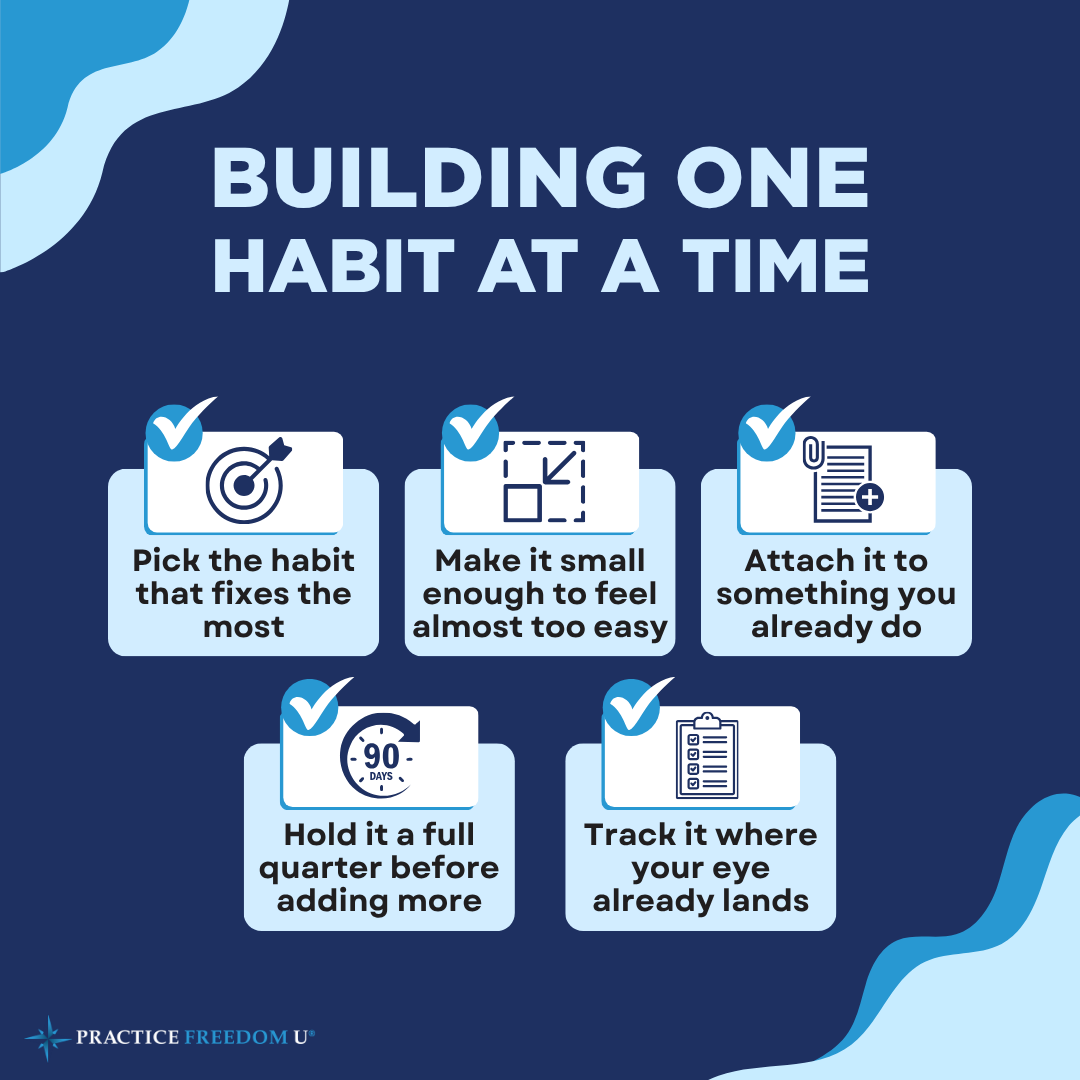
Pick the habit that fixes the most
Reach for the habit that, if it held, would quiet the most noise in your week.
The easiest one to start is rarely the one that matters most.
For you, that might be pausing before you react. It might be a standing block of time to work on the business rather than inside it.
Choose the one whose absence you feel every day.
Write down why this one. In week six, when the newness has worn off and it is just work, you will want that reason in front of you.
Make it small enough to feel almost too easy
The mistake is making the habit big to prove you are serious.
Big habits break first.
Shrink it until it feels almost embarrassing. Write three sentences after you pour your coffee. Hand off a single decision at your next leadership meeting.
The small version survives a bad week. And bad weeks are the only real test.
Attach it to something you already do
You already have a hundred automatic habits. Use them as hooks.
Tie the new behavior to an existing one, and you take remembering out of it.
Right after your morning coffee. Or at the end of your Friday numbers review.
The old habit becomes the cue that pulls the new one along.
Hold it a full quarter before adding more
This is the part that takes nerve.
The moment the first habit starts working, you will feel the pull to add the next one.
Resist it.
A habit only counts as set once it holds without you thinking about it. That takes the full 90 days.
Add the second one before then and you lose the first.
Track it where your eye already lands
Put a mark on the calendar, a tally on the whiteboard, a note in the journal you already keep. Somewhere you look anyway.
Seeing the streak is the point.
Progress you can see does more for your drive than any pep talk. That is the finding behind the power of small wins that Harvard Business Review reported on: steady, visible progress in work that matters is the most reliable motivator there is.
One checked box is a small win, and sixty in a row is a changed business.
Four a year beats ten at once
Two quarters left before the year turns.
Sit with that for a second.
One habit now. One more in the fall. Each chosen well and actually kept, compounding one on top of the next.
That is the cadence that becomes four a year, every year, each one holding because you gave it room.
Against ten more crammed into the back half and gone by August, it is not close.
The owners who pull away from the pack got there by picking one thing, staying with it long enough to matter, and letting it become the floor they build the next thing on.
Before you close this, choose the one habit worth the rest of your summer. Shrink it until it is almost too small to fail, tie it to something already in your day, and leave the rest of the list alone until the leaves change.
One habit at a time.
That is how you reach New Year running a different practice, without ever having burned yourself down to do it.
If this is the kind of thinking you want more of, the Freedom by Design podcast, goes deeper on it every episode. You can find it on Apple Podcasts, Spotify, and YouTube.
————————————————————-
Are you ready for a coach? Join the hundreds of physical therapy owners who are building the practice of their dreams with the support, guidance and direction of a Practice Freedom U Coach. Take the first step towards creating a business that sets you free by scheduling a Discovery Call