
Someone asks what you do at a dinner party.
You say the name of your clinical degree.
Not the name of the business you built, staff you lead, or risk you took to start it.
That answer is a decision. Your practice owner identity is quietly shaping how you run the business, more than your calendar ever will.
The moment the identity shift actually happens
A practice owner I’ve talked with recently ran a multi-location business for over a decade.
Full team, real revenue, real weight on her shoulders.
Ask her on the street what she did, though, and she’d have said one word: clinician.
Owner, CEO, leader, all earned, all skipped.
She kept a caseload while running a growing team, because being needed clinically felt like the whole point.
A coach asked her to practice describing herself differently: the owner who built the practice and leads the team.
That one shift in language changed how she ran meetings, how she delegated, and eventually, how she prepared her business to sell on her own terms.
School trained you to be a clinician, not a business owner. That gap never closes on its own.
The identity you never updated is still setting the ceiling
People carry an old professional identity well past the point where their actual role has changed, as Herminia Ibarra’s research on career transitions has found.
Signing a lease and hiring your first employee doesn’t make you feel like a business owner overnight.
The identity lags behind the role, sometimes for years.
That lag has a cost. See yourself as the clinician first, and you’ll keep making decisions like one.
You’ll hold onto the schedule that should belong to someone else. You’ll avoid the financial conversations that feel like someone else’s job.
You’ll stay the most replaceable, expensive part of your own business.
The fear that keeps the old identity in place
For a lot of owners, the block underneath the logistics is the fear of being seen.
Writing a book. Raising your rates. Stepping back from the caseload. All of it means being visible in a way that invites judgment.
That fear has a name. The original 1978 study on impostor phenomenon found that high achievers often can’t internalize their own success, no matter how much evidence stacks up.
You built the practice. Some part of you still doesn’t believe it counts.
Building a new identity on purpose
Updating how you see yourself takes a few deliberate moves, repeated until they stick.

Say the new title out loud
When someone asks what you do, answer as the owner, not the clinician.
It will feel false for a while. Say it anyway. The feeling catches up to the words.
Write down what you actually built
Most owners have never put their own story on paper. How you present your own work shapes how quickly people trust your expertise, research on written communication and credibility shows, not just what you know.
Even a page describing what you built and what you fixed forces you to see the evidence you keep discounting.
Separate what you love from what only you can do
Loving patient care isn’t a business reason to keep it on your plate.
Ask honestly which parts you’re holding onto because you’re needed, and which because it’s comfortable. Comfortable is fine, but it doesn’t have to keep the business dependent on you.
Let go of the identity that isn’t yours yet
Growth means giving up the version of yourself that got you this far.
Naming who you actually are, out loud, matters more than chasing every new trend to prove you’ve changed.
Start with the next introduction
Next time someone asks what you do, answer with the title you’ve actually earned.
Say it even if it feels like a stretch. That’s the whole practice.
Freedom By Design, Season Two
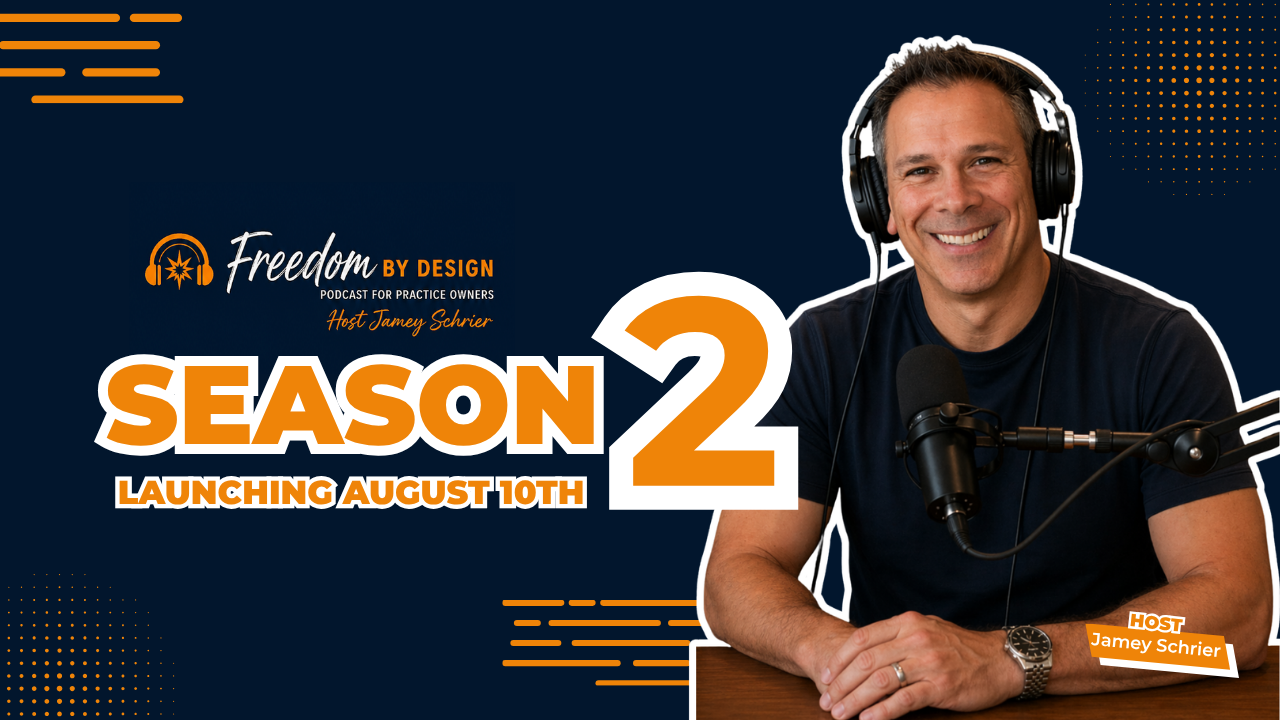
This is exactly what came up in three recent conversations on Freedom By Design with guests Sarah Pettyjohn, Jamie Dykstra, and Sharif Zeid.
Season two is out now on Apple Podcasts, Spotify, and YouTube. These three conversations go deeper into the identity shift that has to happen before anything else in your business changes.
————————————————————-
Are you ready for a coach? Join the hundreds of physical therapy owners who are building the practice of their dreams with the support, guidance and direction of a Practice Freedom U Coach. Take the first step towards creating a business that sets you free by scheduling a Discovery Call