
You hired help expecting relief. The team grew. Payroll increased.
Yet you still feel responsible for everything. The questions come to you. The decisions wait for you. When something goes wrong, you are still the final stop.
This is not a hiring problem. It is a structural one.
If the way you operate does not change, adding staff only increases complexity. Instead of building leverage, you add layers of responsibility.
Hiring Does Not Automatically Create Freedom
There is a critical difference between having employees and having structure. Employees expand capacity. Structure protects energy.
If every meaningful decision still runs through you, you have not truly delegated. You have redistributed activity while retaining ownership. In that environment, your calendar might look slightly different, but your mental load remains unchanged.
This is why many owners feel more tired at $800,000 in revenue than they did at $300,000. The business grew, but the design did not evolve. Instead of treating patients all day, you now treat patients and answer managerial questions. Instead of doing the scheduling yourself, you supervise the person doing the scheduling and recheck their work.
Without structural change, growth increases stress rather than reducing it.
Why You Still Feel Like the Bottleneck
When hiring does not produce relief, the root cause usually falls into three predictable patterns.
1. You Handed Off Tasks Without Defining Results
Saying, “Handle payroll,” or “Manage the schedule,” feels like delegation. It is not. You transferred activity, not accountability.
When success is not clearly defined, including standards, timelines, and review points, you stay uneasy. You double-check. You correct. You step back in.
Delegation only works when responsibility for results shifts. Without defined outcomes, the task may move, but ownership does not. (Forbes)
2. The Process Exists Only in Your Head
Much of your operation runs on instinct. You know how to lead a staff meeting, evaluate a candidate, or handle a difficult patient because you have done it for years.
Your team does not share that context.
When processes are undocumented, they rely on you for interpretation. They hesitate. They ask. You become the default decision-maker.
If stepping away slows the business, that is not a talent issue. It is a clarity issue. Without visible processes, delegation always drifts back to the owner.
3. You Continue to Operate as the Fixer
Even when you understand delegation, you still jump in. It feels faster to do it yourself. Easier to rewrite the email. Simpler to solve the conflict.
In the short term, that feels efficient. Over time, it trains your team to wait for you.
Each rescue reinforces dependence. When this pattern continues, you end up leading capable people who still rely on you for final decisions. That is exhausting.
The Identity Component Most Owners Ignore
For some owners, the fatigue is not just administrative. It is clinical.
You built your practice around patient care. Over time, that work may not energize you the way it once did. Admitting that can feel uncomfortable, even wrong.
But evolving does not mean abandoning your mission. It may mean your highest contribution is building the system, not delivering every service yourself.
If you stay in a role you have outgrown, exhaustion becomes constant. Growth requires shifting your role, not just growing the business.
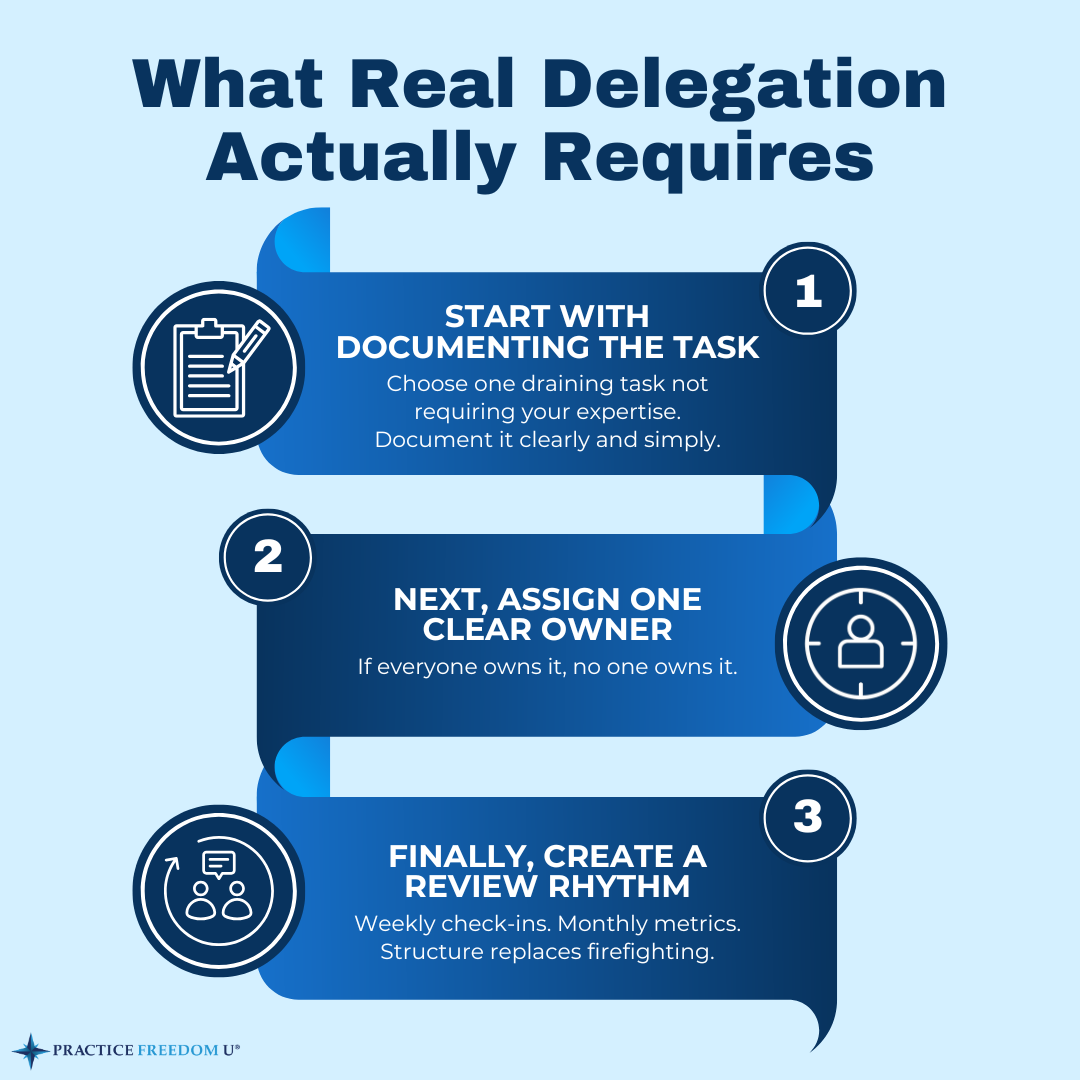
What Real Delegation Actually Requires
If you want your energy back, delegation must be structural, not reactive.
-
Start with documenting the task.
-
Next, assign one clear owner.
-
Finally, create a review rhythm.
Choose one recurring responsibility that drains you but does not require your expertise. Record yourself doing it and outline the key steps. It does not need to be perfect, just clear.
Every recurring responsibility should belong to one person. Shared responsibility usually results in no real ownership.
Establish simple weekly check-ins and monthly metric reviews. Structure reduces the need for constant oversight and keeps you out of daily firefighting. (Entrepreneur)
Start Smaller Than You Think
You do not need to redesign your entire practice this quarter.
Identify one low-energy activity. Document it. Transfer ownership with clearly defined expectations. Schedule a review 30 days later. Then resist the urge to reclaim it at the first sign of discomfort.
The initial relief you feel will not come from eliminating hours overnight. It will come from recognizing that you are no longer the only point of control. That shift alone reduces mental load.
As you repeat this process, energy returns gradually because responsibility becomes distributed rather than centralized. (Instead)
This Is About Design, Not Staffing
A practice that depends on its owner is fragile. A practice built on clear processes, defined roles, and accountability is stable and scalable.
If you hired help and still feel exhausted, the issue is not effort. It is structure.
When structure improves, growth begins to support your life instead of consume it. The shift starts by identifying where you are still the bottleneck.
If you are unsure where that breakdown is happening, take the Practice Freedom Assessment. It will show you which area of the business is creating dependence on you so you can fix the right problem.
Hiring help is not the finish line. Designing a practice that does not revolve around you is.
————————————————————-
Are you ready for a coach? Join the hundreds of physical therapy owners who are building the practice of their dreams with the support, guidance and direction of a Practice Freedom U Coach. Take the first step towards creating a business that sets you free by scheduling a Discovery Call