At some point, this probably felt like the right call.
“We’re a team here. Everyone helps with everything.”
It sounds collaborative. It sounds generous. It sounds like trust.
But if your practice feels heavier than it should, this idea is often a quiet driver.
When everyone helps with everything, nothing is truly owned. Tasks get done, but outcomes stay inconsistent. Problems get addressed, but they resurface. And somehow, the same issues keep finding their way back to you.
Not because your people are incapable.
Because responsibility is too spread out to stick.
Shared responsibility is the problem
Shared responsibility feels good in theory. In reality, it creates gaps.
When something belongs to everyone, no one feels fully responsible for the result. Decisions slow down. Standards vary. Follow-through gets fuzzy. You start hearing things like, “I thought someone else was handling that.”
This is not a communication issue.
It is not a motivation issue.
It is a People structure issue.
Helping is a behavior. Owning is a responsibility.
Someone can help with scheduling. Someone must own scheduling outcomes. Someone can assist with onboarding. Someone must be responsible when onboarding breaks. Without a clear owner, work turns into activity without resolution. (HBR)
Why this always lands back on you
When no one clearly owns an outcome, the practice defaults to its safest option.
You.
So you step in. You double-check. You fix. You decide. Not because you want to, but because you feel you have to. (NIH)
Over time, you become the backstop for everything. The business runs, but only because you are holding it together. That is not leadership failure. That is structural failure.
This is also where quiet frustration builds on the team. High performers start carrying more than their share. Newer staff are unsure where their responsibility ends. Expectations live in your head instead of the business. Everyone is busy, but progress feels slow.
What to do instead, starting now
This does not require a reorg or new titles. It requires clarity.
Start with one recurring area that creates friction. Scheduling, onboarding, billing, cancellations, referrals, pick one.
Then do the following.
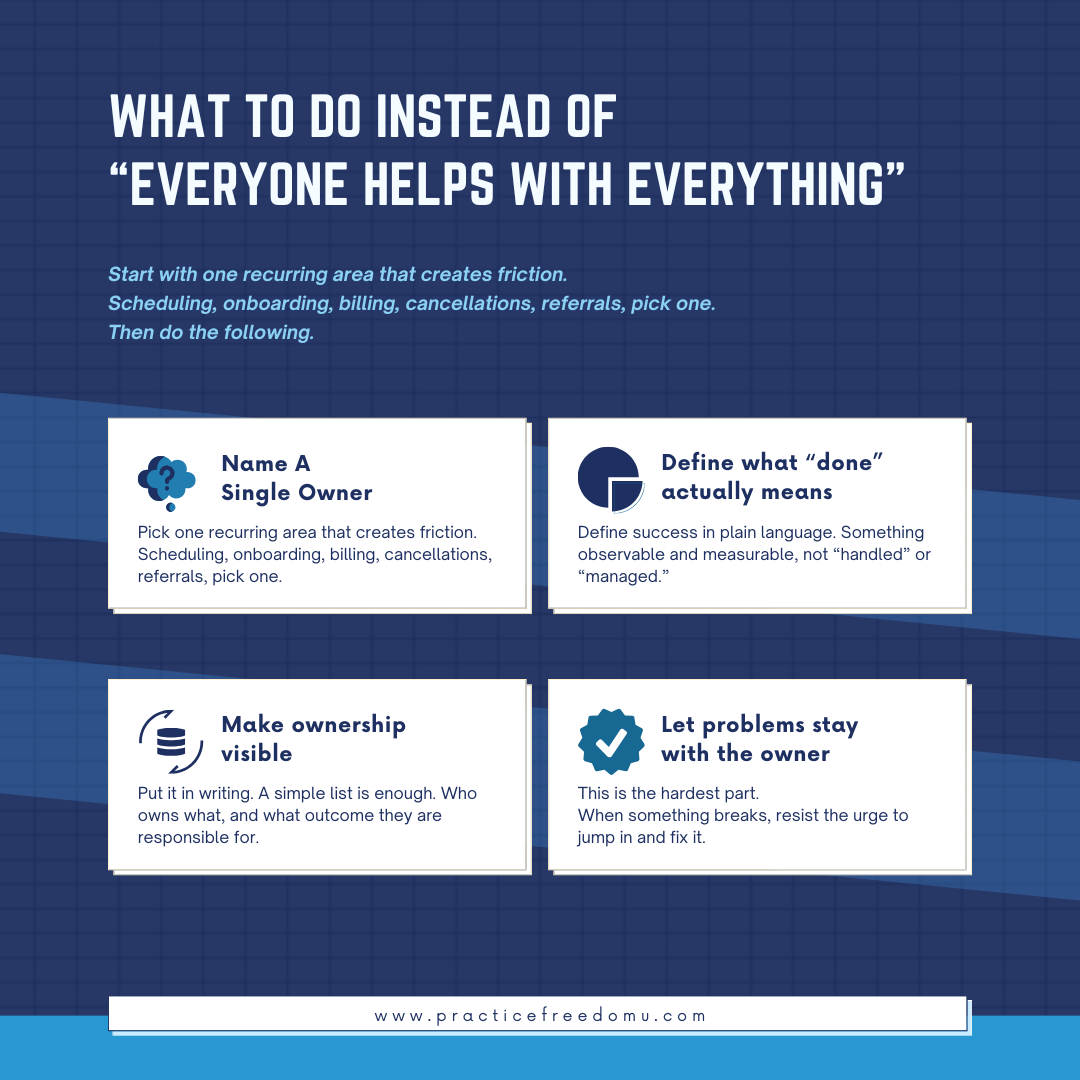
Name a single owner
Pick one recurring area that creates friction. Scheduling, onboarding, billing, cancellations, referrals, pick one.
Assign one person to own the outcome. Not the task. The result.
This does not mean they do all the work. It means when something breaks, it belongs to them first.
Define what “done” actually means
Vague ownership creates vague results.
Define success in plain language. Something observable and measurable, not “handled” or “managed.” If someone else could not tell whether it is done, it is not clear enough. (Fortune)
Make ownership visible
If ownership only lives in your head, it does not exist.
Put it in writing. A simple list is enough. Who owns what, and what outcome they are responsible for. This lone removes a surprising amount of confusion.
Let problems stay with the owner
This is the hardest part.
When something breaks, resist the urge to jump in and fix it. Send it back to the person who owns the outcome and let them work the solution.
This is where relief starts to show up.
A question worth sitting with
If something important breaks in your practice tomorrow, is it immediately clear who owns fixing it?
If the answer is “it depends” or “probably me,” that is your signal.
This is not a mindset issue.
This is not a leadership issue.
It is a People structure issue, and it is fixable.
If this resonated, the Practice Freedom Diagnostic helps pinpoint where role clarity and accountability are breaking down in your practice right now, please.
————————————————————-
Are you ready for a coach? Join the hundreds of physical therapy owners who are building the practice of their dreams with the support, guidance and direction of a Practice Freedom U Coach. Take the first step towards creating a business that sets you free by scheduling a Discovery Call