What happens when you are confident in the treatment room, but uncertain when it is time to lead the business?
That is where imposter syndrome often starts. (Psychology Today)
Clinical skill does not automatically create business confidence. Ownership asks for different decisions, different standards, and a different kind of competence. The discomfort does not mean the owner is unqualified. It usually means the role has changed.
Clinical Skill and Business Confidence Are Different
Most practice owners were trained to become excellent clinicians. They learned how to evaluate, treat, communicate with patients, and make sound clinical decisions. That background matters. It builds trust and gives the practice its foundation.
Business ownership uses a different set of muscles. The owner has to make decisions about pricing, hiring, payroll, profit, team performance, and the direction of the company. These decisions carry more uncertainty because they affect more than one patient or one case.
This is where imposter syndrome in private practice becomes confusing. The owner may feel confident in clinical work and unsure in business conversations. That gap can feel personal, even when it is really a skill gap.
A practice can be built by a strong clinician and still require that person to grow into a stronger owner.
The Limiting Beliefs Behind the Hesitation
Imposter syndrome usually has language behind it. The owner may never say these beliefs out loud, but they often influence decisions.
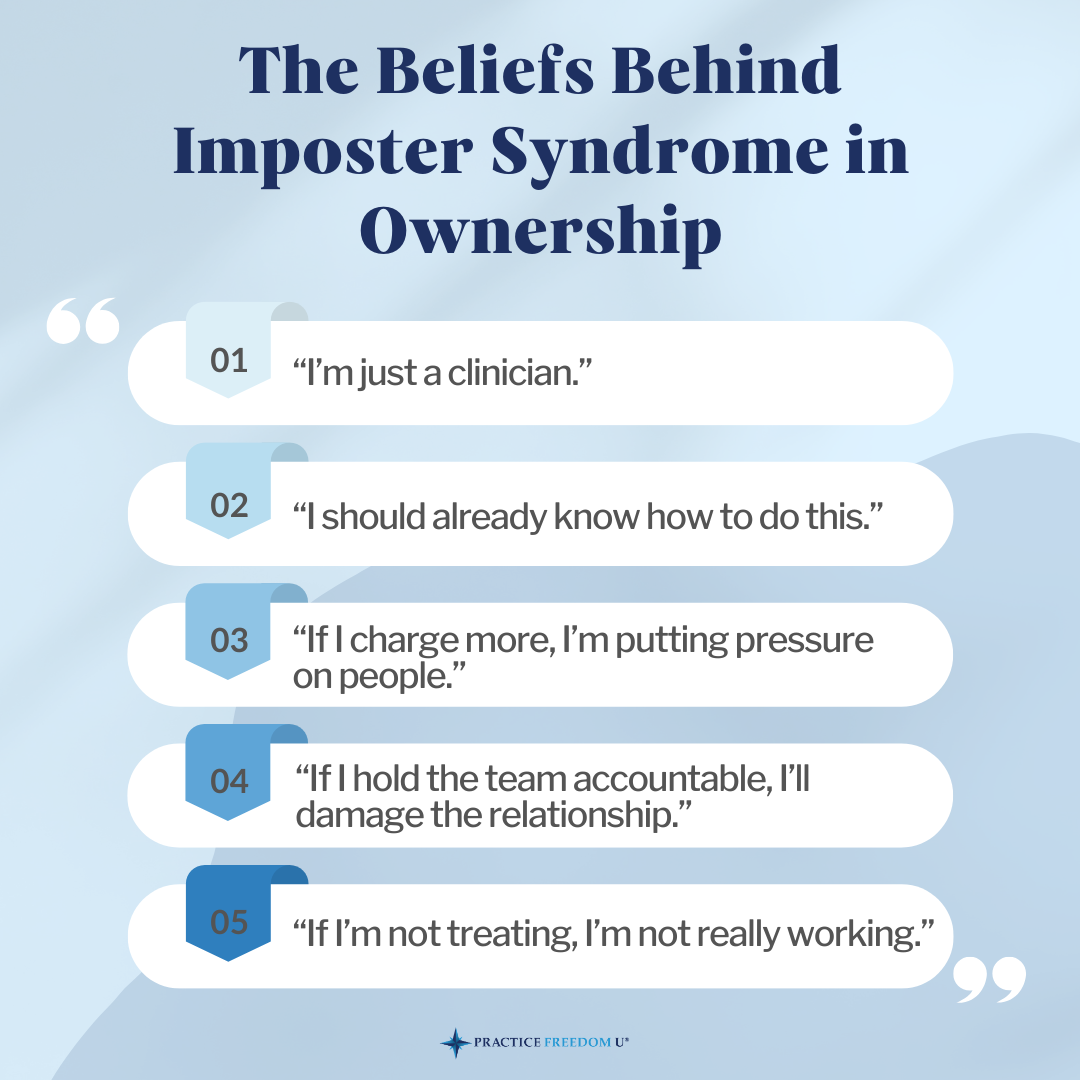
“I’m just a clinician.”
This belief makes ownership feel like something outside the owner’s real identity. The owner may lead the business every day, yet still feel more legitimate in clinical work than in business decisions.
That creates hesitation around money, staffing, accountability, and planning. The owner keeps returning to the work that feels familiar, even when the business needs leadership.
The clinical identity is valuable. It just cannot carry every part of the business.
“I should already know how to do this.”
Many owners assume they should already understand business because they own one. That assumption creates pressure.
Running a practice involves skills most clinicians were never taught. Financial review, leadership communication, hiring, delegation, retention, and strategic planning all require practice.
When the owner treats every gap as a personal flaw, the business becomes harder to lead. A better approach is to name the skill that is missing and build it directly.
“If I charge more, I’m putting pressure on people.”
Pricing can bring up guilt, especially in healthcare. Owners care about access, outcomes, and the people they serve. That care is important, but it cannot replace financial clarity.
A practice needs enough margin to pay the team, improve service, invest in training, and stay stable. Weak pricing usually creates pressure somewhere else, often on the owner, the staff, or the patient experience.
A healthier business gives the practice more room to serve well. (Fast Company)
“If I hold the team accountable, I’ll damage the relationship.”
A lot of owners delay direct conversations because they want to be fair and supportive. The intention may be good, but the result is often confusion.
People need to know what is expected, where they stand, and what follow-through looks like. Accountability becomes much harder when expectations stay vague for too long.
Clear standards make the business easier to work in. They give the team direction and give the owner a cleaner way to lead.
“If I’m not treating, I’m not really working.”
This belief keeps owners tied to the wrong measure of value.
Treatment time feels productive because the result is immediate and visible. Ownership work can feel less concrete. Reviewing the numbers, improving a meeting rhythm, hiring the right person, or developing a manager may not feel as urgent as patient care, but those decisions shape the whole practice.
As the business grows, the owner’s highest-value work changes. The job becomes less about proving value through treatment and more about building a practice that works well.
The Owner Identity Has to Catch Up
The clinician identity often helped build the practice. It brought care, discipline, and responsibility. Those qualities still matter. (Inc)
The problem begins when the owner continues to measure leadership through the old role.
A clinician is responsible for clinical outcomes. An owner is responsible for the health of the business. That includes the people, numbers, systems, standards, culture, and direction.
This shift can feel uncomfortable because it changes what contribution looks like. The owner may spend less time doing the work directly and more time making sure the right work happens consistently.
That is still contribution. It is just a different kind.
Business Confidence Comes From Business Competence
Confidence usually grows after the owner starts building the missing skills. Waiting to feel ready keeps decisions stuck.
Ownership competence includes a few practical abilities:
- Understanding the numbers well enough to make grounded decisions
- Setting expectations the team can actually follow
- Making decisions without waiting for perfect certainty
- Talking about pricing, payroll, and profit without guilt
- Delegating responsibility with clear follow-up
- Addressing problems before they become patterns
These are not personality traits. They are skills. The owner can practice them, improve them, and get support around them.
This matters because imposter syndrome thrives when ownership stays vague. Once the owner can identify the specific skill that needs work, the issue becomes more manageable.
The Next Step Is Clearer Ownership
The goal is not to become less of a clinician. The goal is to stop using clinical work as the only proof of value.
The business now needs the owner to lead with more clarity. That means making decisions sooner, learning the numbers, setting standards, and building the skills that ownership requires.
Imposter syndrome in private practice often quiets down when the owner stops treating business discomfort as a sign of failure. The role changed. The skill set changed with it.
Clinical skill helped start the practice. Ownership competence is what helps it grow.
Listen to Freedom by Design
This is one of the themes behind the Freedom by Design podcast.
The conversations look at what changes when practice owners begin thinking more clearly about leadership, business structure, decision-making, and the role they now hold.
If imposter syndrome has shown up around ownership, the podcast is a good place to keep working through that shift.
You can listen to Freedom by Design on Spotify, Apple Podcasts, and YouTube.
————————————————————-
Are you ready for a coach? Join the hundreds of physical therapy owners who are building the practice of their dreams with the support, guidance and direction of a Practice Freedom U Coach. Take the first step towards creating a business that sets you free by scheduling a Discovery Call