Team meetings can slowly become one of the most frustrating parts of running a business.
The conversation happens every week, but many of the same issues continue resurfacing. Follow-through feels inconsistent, priorities become unclear, and discussions start feeling disconnected from actual progress inside the business.
Over time, meetings can start reflecting the communication and accountability patterns happening across the rest of the team day to day.
Why Team Meetings Start Feeling Unproductive
A meeting can look organized on the calendar while still creating very little operational clarity.
The conversation happens. Updates get shared. Problems get mentioned. But once everyone returns to work, responsibilities still feel blurry and the same issues continue circulating between people.
This usually happens when meetings become centered around discussion instead of ownership.
A team member brings up a scheduling issue, but nobody is clearly responsible for solving it. A communication breakdown gets discussed, but there is no follow-through plan attached to it. Everyone agrees something needs improvement, but the next steps stay vague.
Over time, the meeting starts functioning more like a weekly reset button instead of a place where decisions move the business forward.
5 Reasons Team Meetings Stop Working
When meetings stop feeling useful, it is usually tied to how communication, ownership, and follow-through are functioning across the team day to day.
The meeting simply becomes the place where those patterns become visible.
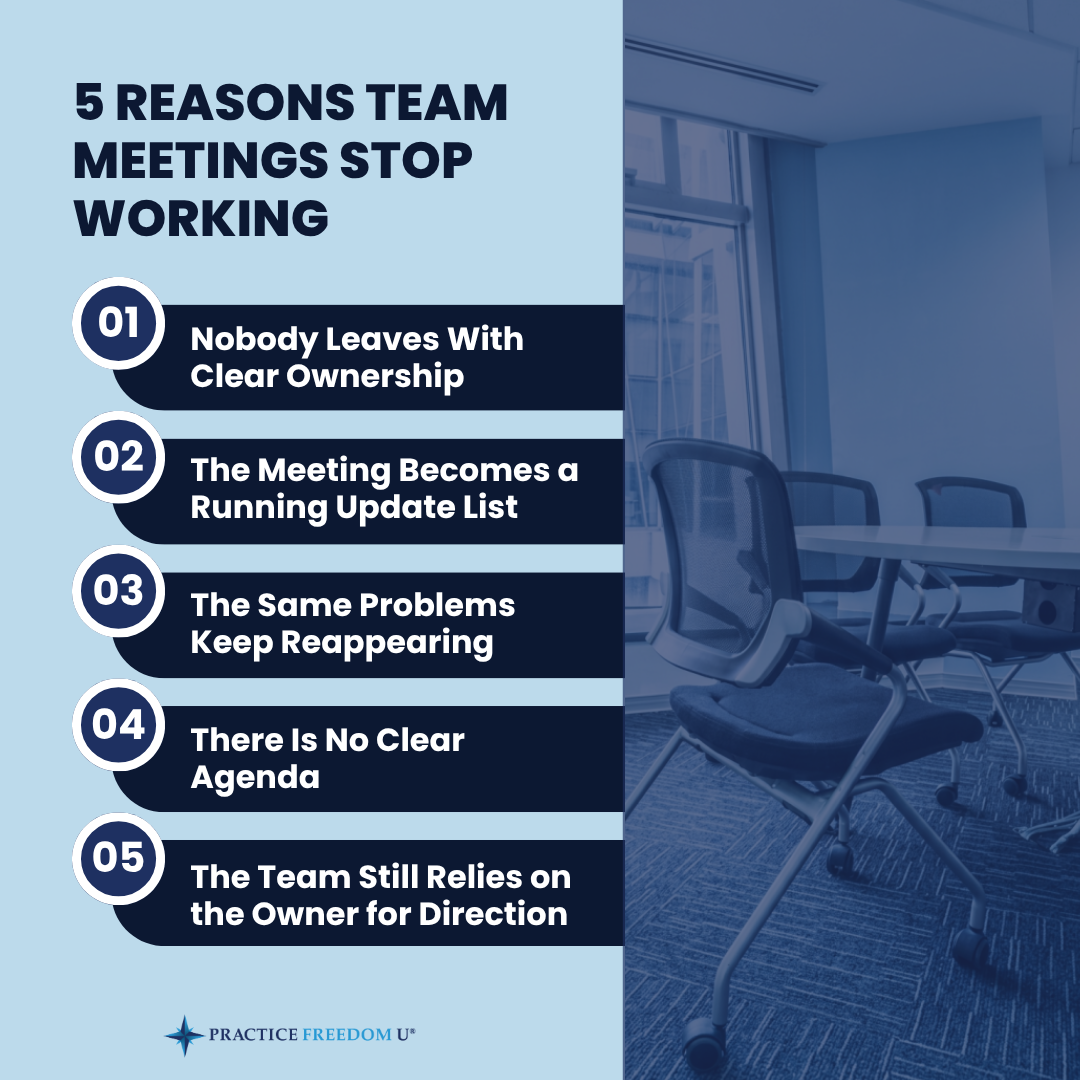
1. Nobody Leaves With Clear Ownership
One of the biggest problems in team meetings is unclear responsibility.
The conversation sounds productive in the moment:
- “We need to improve cancellations.”
- “We should tighten communication.”
- “Someone should follow up with patients.”
But after the meeting, nobody fully owns the outcome.
When ownership is vague, tasks either get delayed, partially completed, or pushed back toward the owner later in the week.
Clear meetings assign clear responsibility. One person owns the next step, the timeline, and the follow-through. (MGMA)
2. The Meeting Becomes a Running Update List
Some meetings slowly turn into a place where everyone simply reports what happened during the week.
The front desk gives updates. Clinicians share concerns. Operations gets discussed briefly. Then everyone moves to the next topic.
The meeting stays busy, but the business itself does not become more organized because very few operational decisions are actually getting resolved.
Good meetings create clarity around priorities, obstacles, and action steps. Without that structure, meetings can start feeling long without feeling useful.
3. The Same Problems Keep Reappearing
When the same issue shows up every week, the team eventually notices.
The scheduling problem keeps returning. Communication gaps continue. Small operational frustrations never fully get cleaned up.
This slowly changes how the team experiences the meeting. Instead of viewing it as productive time, people begin expecting repetition.
Strong employees especially notice this quickly. Repeated conversations without visible resolution make the business feel less organized than it actually may be.
4. There Is No Clear Agenda
Some meetings start without a clear plan for what actually needs to be accomplished.
The conversation moves from scheduling, to staffing, to patient concerns, to random operational updates without much direction. Important topics get rushed while smaller issues take up too much time.
Over time, the meeting starts feeling scattered because nobody knows:
- what the priorities are
- which decisions need to be made
- what requires follow-through
- what could have been handled outside the meeting
A clear agenda creates focus. It helps the team stay organized, keeps conversations productive, and prevents meetings from turning into open-ended discussions about everything happening in the business. (NCBI/PubMed)
5. The Team Still Relies on the Owner for Direction
A common pattern in many practices is the team looking toward the owner for every final answer.
Questions get raised, then the room waits for the owner to decide what happens next. Over time, this creates a meeting environment where the owner carries most of the clarity, problem-solving, and decision-making responsibility.
That structure becomes difficult to sustain.
Meetings become more productive when team members are trusted to own outcomes within their role, not just report problems upward.
What Productive Meetings Actually Create
A productive meeting should reduce confusion during the week.
The team should leave with:
- clear priorities
- defined responsibilities
- deadlines
- decisions
- next steps
Meetings work best when they support accountability instead of replacing it.
That means the business cannot rely on the meeting itself to create follow-through every single week. Ownership, communication, and operational expectations need to exist outside the meeting too.
Otherwise the team becomes dependent on weekly conversations just to stay aligned. (HBR)
More From Freedom by Design

A recurring theme throughout Freedom by Design is that businesses become heavier when too much depends on the owner.
Team meetings often reveal where that is happening.
When communication, ownership, and follow-through become clearer across the team, meetings usually become simpler, shorter, and far more productive.
For more conversations around building a business that operates with greater clarity and less owner dependence, watch or listen to Freedom by Design on YouTube, Spotify, and Apple Podcasts.
————————————————————-
Are you ready for a coach? Join the hundreds of physical therapy owners who are building the practice of their dreams with the support, guidance and direction of a Practice Freedom U Coach. Take the first step towards creating a business that sets you free by scheduling a Discovery Call