

Five financial behaviors strong owners repeat
Most practice owners think they are “bad with money.”
They are not.
They are simply unclear. And clarity changes everything.
If you are tracking your numbers monthly, even imperfectly, your practice is already more mature than you give it credit for.
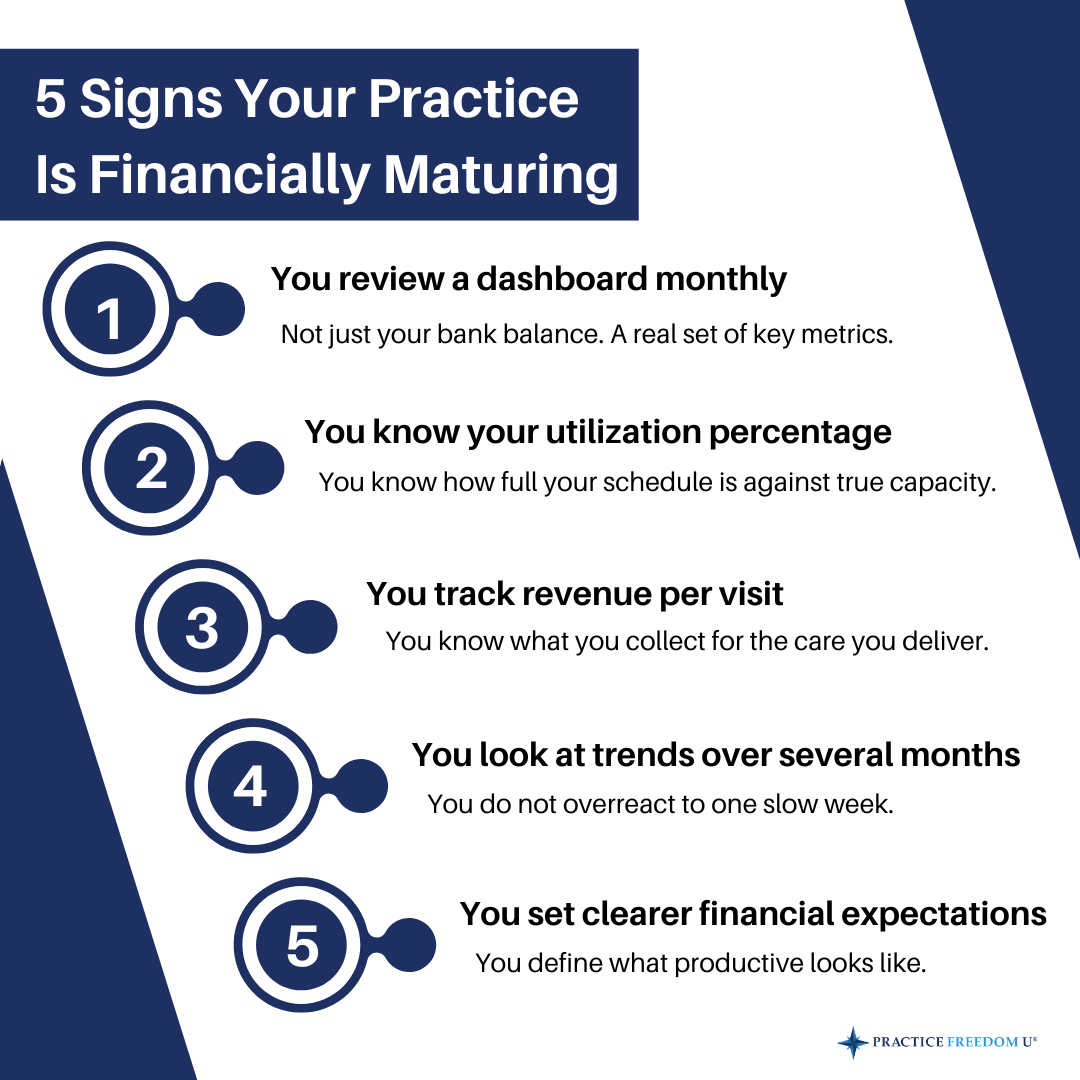
You Are Looking at More Than Just Revenue
There was a time when the only number that mattered was total revenue. Now you know better.
Revenue alone does not tell you if the practice is healthy. It does not tell you if the team is productive. It does not tell you if the schedule is efficient. And it definitely does not tell you if you are profitable.
When you begin looking at metrics like:
- Utilization percentage
- Visits per FTE per day
- Revenue per visit
- Profit per visit
You are thinking like an owner, not just a clinician. And that shift matters. Utilization is the most important operational metric because it reflects how productive your team is compared to capacity.
If you are even aware of that number each month, you are operating at a higher level than most. That is growth.
You Understand That Capacity Matters
Many owners assume they are “busy.” Busy is not a metric. Capacity is.
Total capacity represents how many visits your clinicians could treat if every slot were filled. When you compare actual visits to capacity, you see truth without emotion.
That is maturity. If you know:
- How many FTEs you have
- How many work days are in the month
- How many visits per day each clinician can realistically handle
Then you are no longer guessing. You are measuring. And as we know, what gets measured improves. Even tracking this consistently reduces stress because it replaces assumption with data.
You Are Thinking in Trends, Not Moments
One slow week no longer sends you into panic. You look at trends.
- When utilization drops, you know to check new patients and cancellations.
- When revenue per visit dips, you consider billing habits or collections.
- When profit tightens, you examine expenses in context of productivity.
That is not reactive thinking but executive thinking.
The first place to look is utilization because low utilization almost always explains financial stress.
If you have trained yourself to look there first, you are no longer emotional about money. You are analytical. That is a major shift.
You Are Setting Targets Instead of Hoping
This may be the most powerful sign of financial maturity. You no longer say:
“Somewhere between 12 and 16 visits per day is fine.”
You decide clear targets that reduce confusion and increase productivity
When your team knows the expectation, performance stabilizes. Strong practices are clear on:
- Target utilization percentage
- Target visits per new patient
- Target cancellation rate
- Target revenue per visit
You do not need perfection. You need clarity. If you have begun defining targets instead of operating in ranges, your financial leadership is improving.
You Understand That Profit Is Operational, Not Emotional
Profit is not a feeling. It is revenue minus expenses, but mature owners understand something deeper. All financial outcomes are the result of operational metrics
Revenue depends on:
- Visits
- Billing accuracy
- Collections
Expenses depend on:
- Staffing structure
- Utilization
- Capacity decisions
When you connect operations to money, the fear around finances decreases.
You stop asking, “Why is profit down?” and start asking, “Which metric moved?”
That is how strong practices think.
Strong financial management is not complexity
It is simplicity repeated.
A few key metrics.
Clear targets.
Monthly review.
Calm decisions.
Money only feels chaotic when it is unclear. The moment you can answer these questions confidently, stress drops:
- Are we utilized properly?
- Are we bringing in enough new patients?
- Are we collecting what we should?
- Are expenses aligned with capacity?
Clarity builds confidence, confidence builds freedom. And that is the real point of tracking your numbers.
You do not need to be a financial expert. You need clarity and consistency.
When you track the right key financial metrics in your private practice, money becomes predictable. Decisions become calmer. Growth becomes intentional.
This is not dramatic transformation but disciplined progress.
And if you are already doing this, you are building something far more stable than you realize.
If you want to see how strong your financial foundation truly is, take the Practice Freedom Assessment. It will show you exactly where you stand and what comes next.
————————————————————-
Are you ready for a coach? Join the hundreds of physical therapy owners who are building the practice of their dreams with the support, guidance and direction of a Practice Freedom U Coach. Take the first step towards creating a business that sets you free by scheduling a Discovery Call