

If referrals have flattened, most owners jump to the wrong conclusion.
They assume the market changed.
They assume referral partners forgot about them.
They assume they need more lunches, more coffees, more effort.
In most cases, none of that is true. (Journal of Marketing)
Referral plateaus usually happen because the practice has outgrown the referral structure that once worked. What brought you to this level is no longer designed to take you further.
This is not a motivation issue. It is a design issue.
Why Referral Plateaus Happen in Established Practices
Referral systems often start informally.
They grow through personal relationships.
They rely on memory and goodwill.
They live inside the owner’s head.
That works early. It stops working at scale.
As the practice grows, expectations change. Capacity changes. Team involvement increases. If the referral process does not evolve, friction builds quietly and referrals slow without warning.
The solution is not more effort. It is a reset.
The Referral Reset
This reset is not about starting over. It is about tightening focus and removing friction.
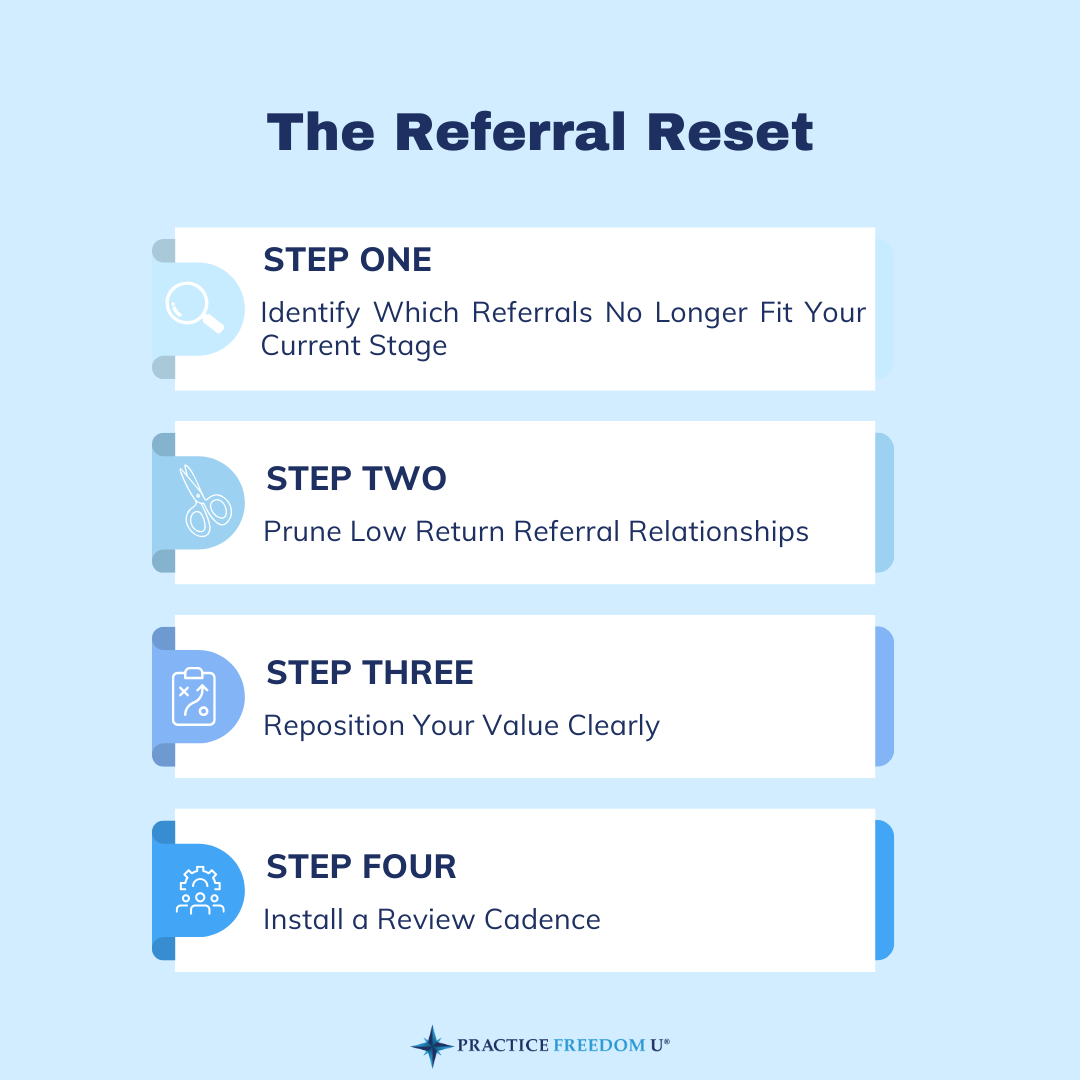
Step 1. Identify Which Referrals No Longer Fit Your Current Stage
Not every referral source should come with you to the next phase of growth.
Some partners were a great fit when your schedule was open and you treated most patients yourself. At scale, those same referrals may strain access, overwhelm staff, or dilute outcomes.
Ask three questions:
- Are these referrals aligned with who we serve today?
- Do they match our current capacity and care model?
- Do they strengthen or complicate operations?
Clarity here creates leverage later.
Step 2. Prune Low Return Referral Relationships
This is the step most owners avoid.
Not all referrals are equal. Some consume time, energy, and capacity without producing consistent value.
Low return relationships usually show up as:
- High volume, low conversion
- High complexity, low margin
- Frequent exceptions and workarounds
Pruning is not rejection. It is prioritization.
Focus creates momentum. (Entrepreneur)
Step 3. Reposition Your Value Clearly
Referral growth depends on understanding.
If referral partners cannot clearly explain:
- who you help
- what makes you different
- and when to send someone your way
they will not refer consistently.
Repositioning is not marketing language. It is operational clarity.
This is where most practices drift. They try to be easy to refer to, but end up being vague.
Specific beats broad. Always. (Forbes)
Step 4.
Referrals should never be passive.
Set a simple rhythm:
- Monthly review of referral volume and quality
- Quarterly evaluation of referral fit
- Ongoing adjustment based on capacity and outcomes
Consistency comes from attention, not effort.
What Changes After the Reset
After a proper referral reset, practices notice:
- fewer referral emergencies
- better patient fit
- stronger conversion
- less owner involvement
Most importantly, referrals stop feeling fragile.
They become predictable.
Final Thought
If your practice has plateaued, it does not mean something is broken.
It means you have outgrown your old referral structure.
The reset is not about doing more. It is about doing what fits the business you are running now.
If you want clarity on where your referral system is creating friction and what to fix first, the Practice Freedom Assessment will show you exactly that.
Clarity comes before growth.
————————————————————-
Are you ready for a coach? Join the hundreds of physical therapy owners who are building the practice of their dreams with the support, guidance and direction of a Practice Freedom U Coach. Take the first step towards creating a business that sets you free by scheduling a Discovery Call