
For years, private practice owners in the $500,000 to $5 million range have been the backbone of independent healthcare. Physical therapy, pediatric therapy, speech and language, mental health, and allied health practices sit squarely in that group.
That position once offered stability. In 2026, it is the most exposed. This is not a dramatic prediction. It is a pattern already showing up across the industry and inside hundreds of practices nationwide.
This article starts as a warning.
Then it becomes a rallying cry.
Why the Middle-Class Private Practice Is Being Squeezed
Middle-class practices are stuck in the most dangerous position.
They are too small to compete on scale.
They are too big to run purely on owner effort.
And they are still heavily dependent on reimbursement models that no longer support sustainable margins.
That combination no longer works.
1. Reimbursement Is Falling Behind Costs
Reimbursement is not keeping up with the cost of delivering care.
Medicare and commercial payer adjustments have consistently failed to match inflation. At the same time, operating expenses continue to rise. (APTA)
Costs that have increased significantly include:
- clinician wages and benefits
- rent and facility expenses
- software and technology
- compliance and administrative overhead
This is not unique to physical therapy. Mental health, speech therapy, and pediatric practices are experiencing the same margin pressure. (ASHA)
The old belief that higher volume automatically leads to higher profit is breaking down.
2. Hiring Has Become a Structural Problem
Many owners still believe hiring challenges are temporary.
They are not.
Across allied health professions, workforce shortages are persistent (APTA). Practices report:
- limited capacity to meet demand
- rising wage pressure
- intense competition for qualified clinicians
Middle-class practices feel this most.
They lack the recruiting infrastructure and compensation leverage of larger organizations. At the same time, they are too large for the owner to personally carry the caseload and manage operations.
This creates constant strain and instability.
3. Consolidation Is Already Happening
Consolidation in private practice healthcare is no longer theoretical.
Larger groups are expanding. Private equity continues to invest in healthcare services. (The Commonwealth Fund) Buyers prioritize practices with:
- strong systems
- leadership beyond the owner
- predictable performance
- clean financials
Many middle-class practices are not built this way.
They are not small enough to pivot quickly.
They are not structured enough to command strong valuations.
Instead of failing suddenly, they slowly bleed.
4. Insurance Dependence Is Now a Liability
Most middle-class practices remain heavily dependent on insurance reimbursement.
That dependence creates fragility.
One payer decision.
One rate adjustment.
One policy change.
Without pricing power or diversified revenue streams, the practice absorbs the impact.
Over time, this erodes stability, options, and owner freedom.
5. Technology Is Widening the Gap Between Practices
Technology is not replacing clinicians.
It is replacing inefficiency.
Practices that automate documentation, intake, scheduling, follow-up, and internal systems operate at a fundamentally different cost structure.
Middle-class practices often sit in the worst position.
Too complex to run manually.
Too disorganized to fully leverage technology.
That gap is widening quickly.
The Real Problem
The middle-class private practice depends on conditions that no longer exist.
Stable reimbursement.
Plentiful clinicians.
The owner holding everything together.
That world is gone.
The Good News: Independent Practice Is Not Dead
Here is the shift most owners miss.
Independent private practice is not dying.
Drifting is.
Practices that thrive in 2026 and beyond will make intentional decisions and choose a clear path forward.
There Are Only Two Viable Models Going Forward
Option 1: Scale and Systems
This model wins through operational excellence.
Key characteristics:
- clear leadership layers
- standardized workflows
- strong financial visibility
- disciplined hiring and utilization
- technology that reduces friction
This path creates leverage and consistency.
Option 2: Boutique and Premium
This model wins through differentiation.
Key characteristics:
- clear niche focus
- higher pricing tied to value and outcomes
- reduced insurance dependence
- strong referral relationships
- premium client experience
This path creates pricing power and demand.
Both models work.
Trying to live in the middle does not.
What Middle-Class Practices Must Do to Survive and Thrive
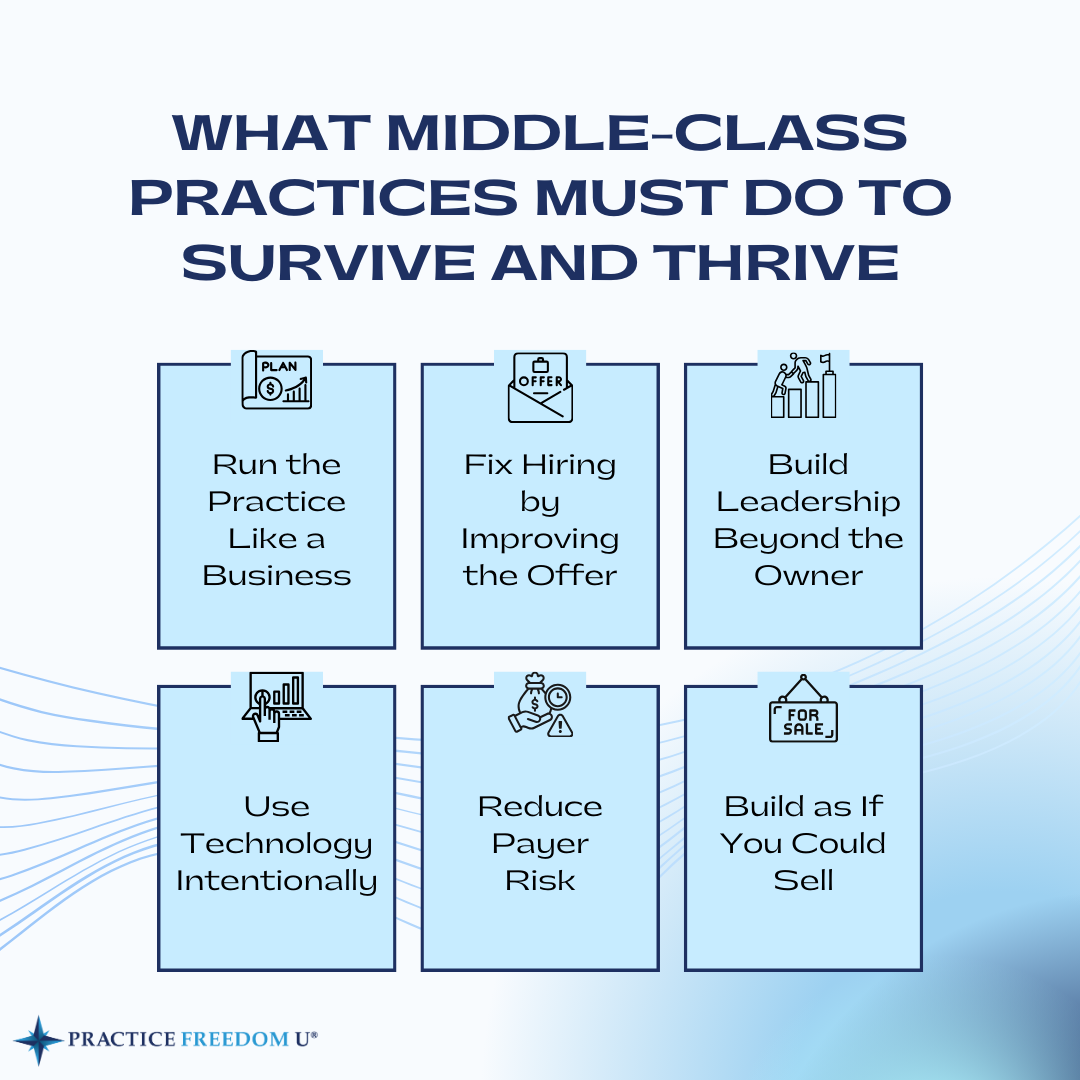
Run the Practice Like a Business
Every owner must understand core metrics:
- revenue per clinician
- labor cost percentage
- cost per visit
- payer mix
- cancellation and no-show rates
- true profitability
Avoiding the numbers delays reality.
Fix Hiring by Improving the Offer
Practices that attract talent:
- create growth paths
- reduce unnecessary administrative burden
- invest in leadership and culture
- respect time and energy
The market rewards clarity and structure.
Build Leadership Beyond the Owner
If everything runs through the owner, the practice is fragile.
Develop leaders.
Delegate decisions.
Create accountability.
This is how practices stabilize and grow.
Use Technology Intentionally
Technology is a multiplier, not a fix.
When fundamentals are solid, technology increases efficiency and margin. When fundamentals are weak, it adds complexity.
Winning practices are deliberate.
Reduce Payer Risk
No practice should depend on one or two payers.
Diversification creates resilience:
- premium services
- employer partnerships
- hybrid or cash-based offerings
- non-visit-based programs
Options create stability.
Build as If You Could Sell
You do not need to sell your practice.
But building as if someone could buy it forces discipline, systems, leadership, and profitability.
That mindset creates freedom.
The Bottom Line
The middle-class private practice is dead because the middle no longer works.
You either evolve into a real business with leverage and systems, or you remain trapped by shrinking margins and rising complexity.
2026 will not be kind to indecision.
But for owners willing to choose a direction and lead differently, it can be the most powerful chapter yet.
What to Do Next
If you are unsure how exposed your practice is to these pressures, clarity is the first step.
We start with a Practice Assessment to identify risk, constraints, and opportunities.
That assessment is followed by a Free Review, where we walk through the results and outline realistic paths forward.
No pressure. No selling.
Just clarity.
————————————————————-
Are you ready for a coach? Join the hundreds of physical therapy owners who are building the practice of their dreams with the support, guidance and direction of a Practice Freedom U Coach. Take the first step towards creating a business that sets you free by scheduling a Discovery Call