“I can’t afford it.”
Have you ever said those words?
I have. Many times.
And for a long time, I thought they were just practical.
Responsible. Adult. Conservative.
They’re not.
They’re conditioning.
Here’s what’s actually happening under the surface.
The Phrase Sounds Practical. It Isn’t.
When your brain says “I need this” but your mouth says “I can’t afford it,” you create internal conflict.
Your nervous system does not experience that as logic.
It experiences it as threat.
Scarcity language activates the same part of the brain that responds to danger. Cortisol rises. The part of the brain responsible for strategic thinking, long-term planning, and creativity goes quiet.
In that moment, the issue is no longer money.
It is safety.
What “I Can’t Afford It” Actually Does to Your Brain and Behavior
This is where the real damage happens, not in the spreadsheet, but in the state you lead from.
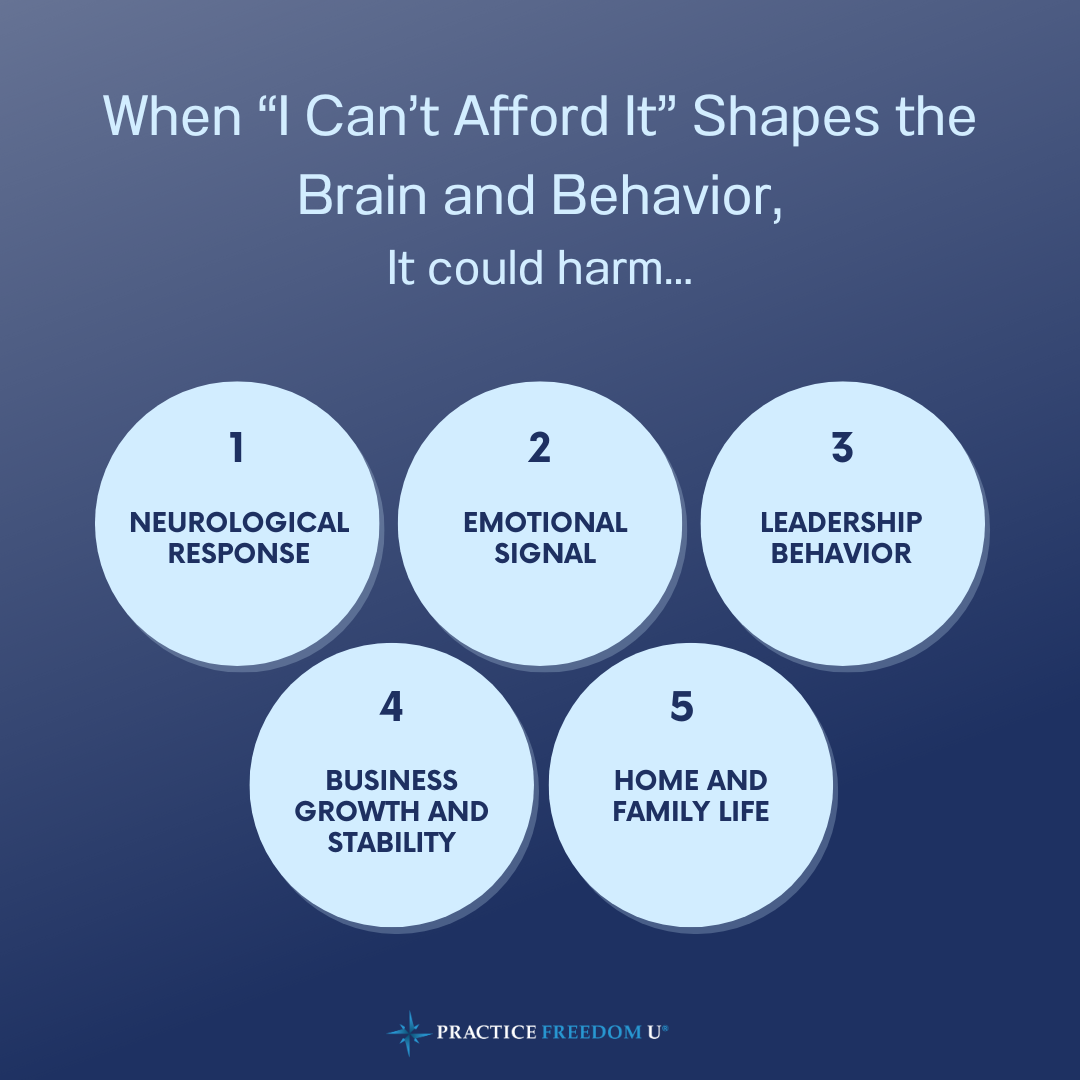
The neurological response it triggers
When scarcity language shows up, the limbic system takes over. (MDPI)
This is the part of the brain designed for survival, not leadership. It narrows focus, speeds reaction, and prioritizes protection. Meanwhile, the prefrontal cortex, the part responsible for reasoning, creativity, and long-range thinking, goes offline.
In other words, you stop thinking like a leader and start reacting like someone trying to survive. (Deloitte)
That shift alone changes every decision that follows.
The emotional signal it reinforces
“I can’t afford it” does not land in the brain as a neutral statement.
What your brain actually hears is:
- I don’t have options
- I’m stuck
- I’m not capable of figuring this out
- This is as good as it gets
Say that often enough and it stops being situational. It becomes belief.
Once it becomes belief, it starts driving behavior without your permission.
The leadership behaviors it creates
From that place, leadership contracts.
You delay decisions that would create leverage.
You stay in operator mode longer than you should.
You choose short-term relief over long-term freedom.
You keep asking, “How do I do more?” instead of “How do I redesign this?”
This is not because you lack discipline or ambition.
It is because scarcity thinking rewards caution and punishes expansion.
The business consequences that follow
Over time, this does real damage in your business.
Scarcity thinking makes you protect the business instead of build it.
You hold on to familiar workflows even when they limit growth.
You postpone support because it feels risky.
You become essential to everything, which makes the business fragile instead of durable.
Growth feels heavy. Decisions feel stressful. The ceiling stays in place, even when revenue increases.
The family and generational impact
This does not stop at the office.
Kids do not learn money from spreadsheets.
They learn it from emotional tone.
When they hear “we can’t afford that,” what they often internalize is:
- Money is stressful
- Wanting more is dangerous
- Growth equals risk
- Safety comes from playing small
You may think you are teaching responsibility.
You are often teaching fear.
Why This Is Not a Money Problem
Most of the time, “I can’t afford it” does not mean you lack money.
It means you do not trust future you.
You do not trust your ability to create.
You do not trust yourself to solve problems bigger than today.
That is not a financial issue.
That is an identity issue. (APA)
The Reframe Leaders Use Instead
There is a better question.
Not, “Can I afford this?”
But, “What would I need to believe, change, or build to make this inevitable?”
One question shuts the door.
The other turns the lights on.
This does not mean reckless spending.
It means responsible leadership.
Leaders do not ask what they can afford today.
They design for what they are committed to creating tomorrow.
If this hit a nerve, good.
That is usually where the growth is.
The language you use becomes the future you live in.
If you are ready to see how scarcity thinking is quietly shaping your decisions, your business, and your family, start with clarity.
The Practice Freedom Assessment helps you see where you are operating from survival instead of design, and what needs to change to move forward with intention.
That awareness is the first real step toward freedom.
————————————————————-
Are you ready for a coach? Join the hundreds of physical therapy owners who are building the practice of their dreams with the support, guidance and direction of a Practice Freedom U Coach. Take the first step towards creating a business that sets you free by scheduling a Discovery Call